

by Jodi Tang
I am officially having a crisis of faith regarding minimalism.
It starts in design school, doesn’t it? The brainwashing is efficient. You are sat down and told that clean lines are virtuous and ornament is a lie. If you dare to decorate a building, you are hiding its truth. We are trained to worship the International Style, that endless parade of glass, steel, and empty space, as if it’s the only sophisticated way to exist.
My mother went on a solo trip to Taiwan last week, and true to the Asian Mom archetype, she has been sending me a strict quota of about 100 photos a day. But while scrolling through this barrage of JPEGs, I realized something depressing: the new stuff is boring. My eyes just glazed over the glass boxes and generic high-rises.
Instead, I found myself zooming in on the background details, specifically, the 1970s shophouses with those rusted, chaotic, absolutely beautiful iron grilles covering the windows. Maybe I’m just getting old and sentimental, but lately, I’ve been doing the exact same thing back home. I find myself wandering around Singapore’s traditional shophouse districts(Blair Road & Chinatown), totally liúlián wàngfǎn (流连忘返), lingering, reluctant to leave, and obsessed with the textures we’re slowly erasing in modern architecture.
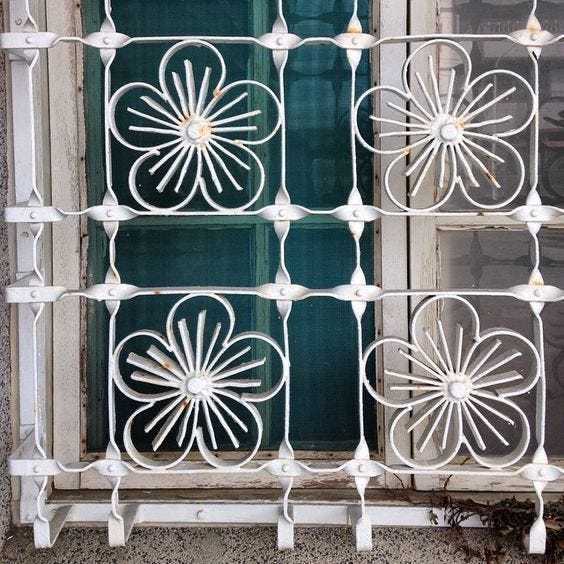
To an architect, these Iron Window Grille probably look like “cages.” They’re aggressive symbols of crime. But standing there, looking up at a grille bent into the shape of a mountain or a blooming flower, I didn’t feel unsafe. I felt delighted? It was a stark realization: what we were taught to dismiss as clutter is actually just personality.
We need to talk about Adolf Loos.

If you want to know why our cities feel so sterile today, you have to blame this guy. In 1908, the Austrian architect published Ornament and Crime (Ornament und Verbrechen), an essay that effectively ruined modern aesthetics for the rest of us.
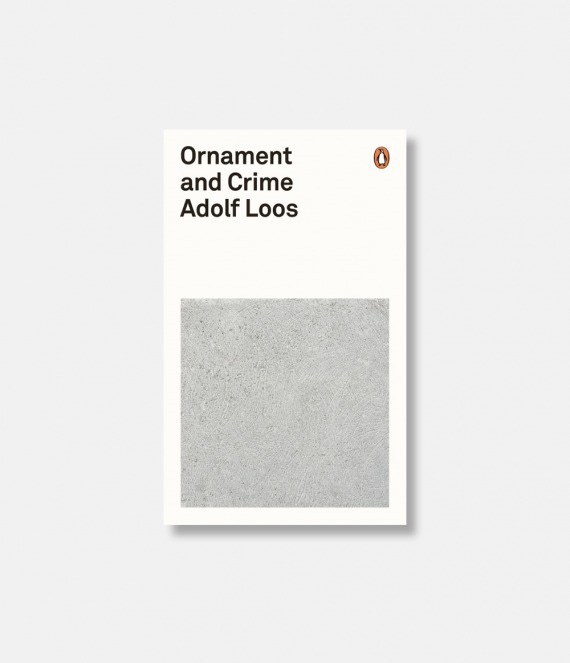
Loos believed ornament was a sign of moral regression. He famously wrote that the evolution of culture is synonymous with stripping ornament from everyday objects.
The audacity is breathtaking, really. His argument was explicitly Eurocentric, comparing ornamentation to the tattoos of “primitive” tribes, implying that a civilized modern person has evolved past the need for beautiful things. This ideology bled out from Vienna, infected the Bauhaus, and eventually took over the architecture schools of Asia. We were told that “Modern” = “Minimal,” and that the “Iron Window Flowers” (Tie Chuang Hua) of our own heritage were just kitsch.
Fortunately, the Asian homeowners of the 1970s didn’t care about European theory.
During the economic boom, families moving into new apartments had a very real need for security bars. But they refused to make them invisible. Instead of accepting the International Style box, they remixed it. While Loos declared ornament a crime, the Asian auntie decided it was a necessity.
They commissioned blacksmiths to twist steel into coins, landscapes, and text. They turned a security feature into a status symbol. It was Vernacular Modernism at its best, using industrial materials to tell traditional stories.
Next time you spot a rusted grille, take a closer look. Here are the three most common dialects you’ll see on the street:
The Flex (The Mount Fuji)
The Look: A triangular peak, often topped with a white-painted snow cap.
The Secret: It’s usually a hangover from Japanese colonial influence or just a homeowner dreaming of travel. It’s a technique called “borrowing a view” (shakkei), you create a landscape on your window because the actual view outside is probably just your neighbor’s laundry.
The Trap (The Coin)
The Look: Interlocking circles or squares with holes.
The Secret: This is spiritual capitalism. It’s literal Feng Shui architecture. Placing coin symbols on the window was believed to trap wealth inside the home, physically preventing your fortune from flowing out the window.
The Brand (The Typography)
The Look: English letters or Traditional Chinese characters twisted into the grid.
The Secret: In the 70s, your house was your resume. A music teacher might have a grille bent into a treble clef; a wealthy family might weave their surname right into the steel. It was the original Personal Branding.
Adolf Loos might have won the battle for our skylines, most new buildings are still glass and steel clones, but he didn’t win the culture. These iron flowers prove that we don’t have to live in the sterile boxes we were sold. Design can be functional and symbolic. It can be secure and beautiful.
So the next time you feel the urge to “clean up” your work too much, just remember that these Iron Window Grilles are here to remind us that intentional clutter is good for your soul.
The best thing about iron window grilles are the shadows they cast on the pavement or on the walls when the sun hits them just right!
J’adore! I’m an Italian interior design designer based in France, “eurocentrist” by birth but attracted by your faraway cultures, and even if I am a minimalist by heart and practice, I totally understand your point of you. You cannot just strip a country from its culture, from its patterns and textures. We need to stay true to what was brought to us from our own past. and decoration isn’t wrong as it is, it’s just its accumulation in our vital space that makes it “the evil to fight”.