

By Koh Ting Jia
The coffin that could fly
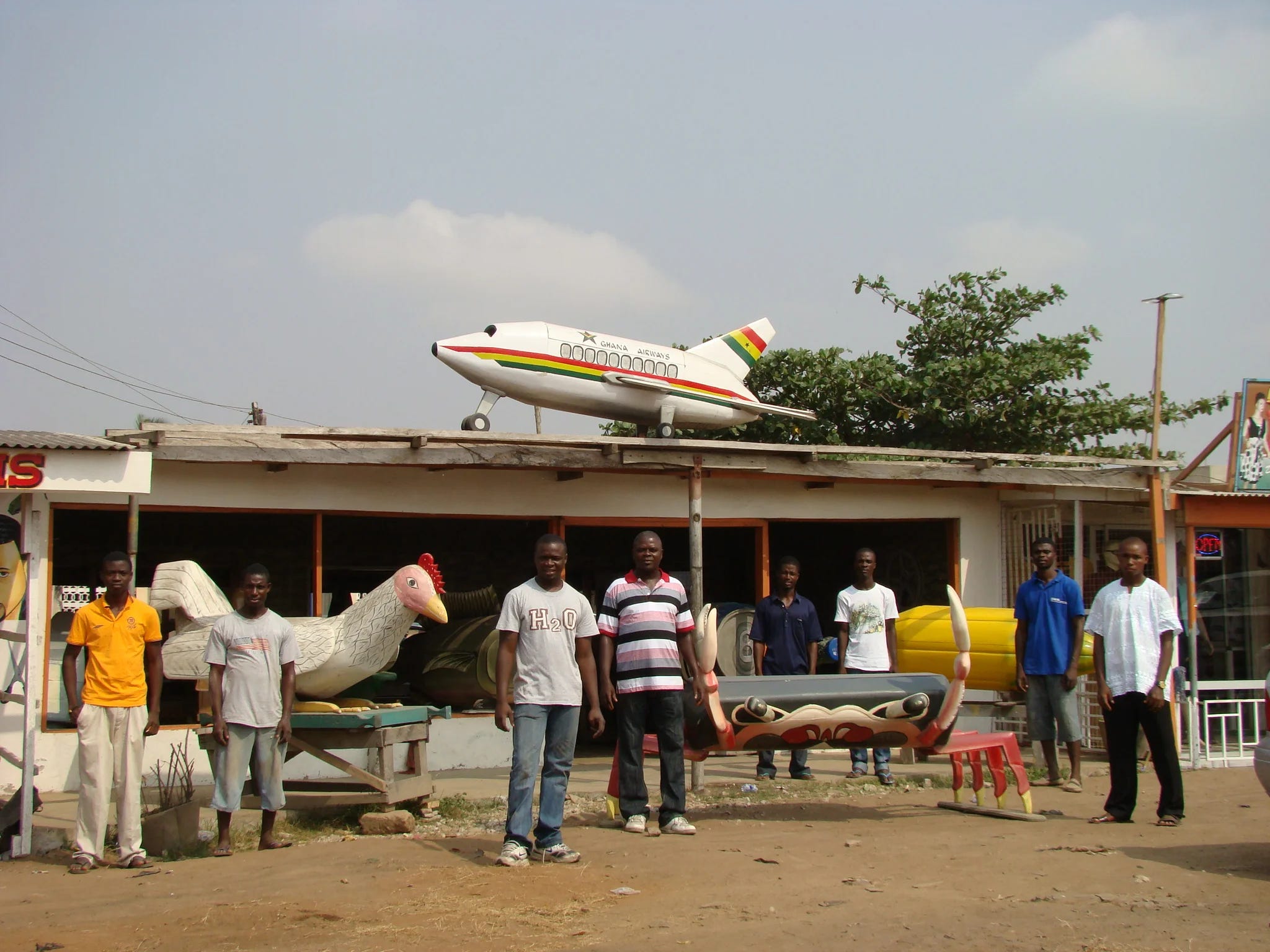
Funerary Processions, photographed by Secretan Thierry in “Going into Darkness”
Have you heard of the coffin that could fly? Carpenter Seth Kane Kwei’s grandmother, who grew up in Teshie, a coastal suburb near Accra’s airport, was enthralled by the mystique of flying. While she spent her time witnessing the whirs of plane engines and their contrails, she never experienced sitting in such a contraption. In the wake of her passing, when Seth built her an airplane-shaped coffin, he not only honoured her dreams, but also completed her journey in her death. This led to the inception of the Fantasy Coffins of Ghana, as we know them today. To Seth, death was not an end in itself, but a celebration of what was, and an actualisation of aspirations.
Yet, who is allowed to be given such a return, and how does such a tradition compare to other parts of the world? In this essay, we seek to unravel the reasons for the Fantasy Coffin’s existence, who gets a good and bad death in Ghana, and what fantasy coffins tell us about the subjective human beliefs of death and life.
History and Context of the Coffins of Ghana:
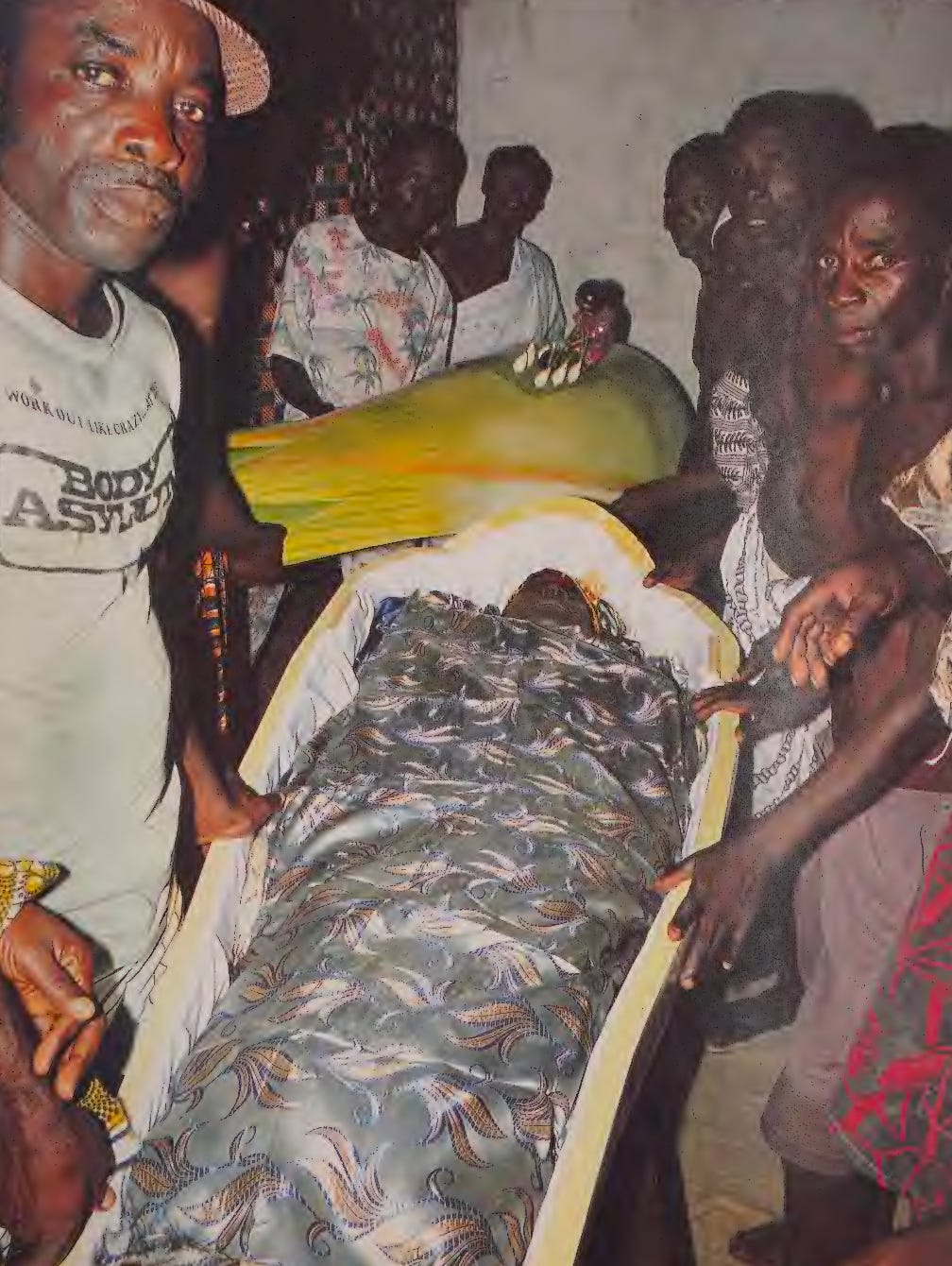
Funerary Processions, photographed by Secretan Thierry in “Going into Darkness”
The coffins are called “abebuu adekai”, Ghanaian for “proverb box”, ironically with designs conceptualised out of the box — objects the coffins are made to communicate professions, achievements, and unrealised dreams. Strikingly, the coffins themselves are found across faiths in Ghana, eliciting that the coffins communicate an ethnocultural view of death rather than a religious one. According to Thierry, who had done fieldwork on the fantasy coffins in “Going into Darkness”, the coffins are usually accompanied by elaborate funeral processions, where the deceased are placed on a bed and surrounded by songs and buried with cash. After, they are transferred into the coffin and nailed shut. Lastly, the coffin is carried by family members around town, to places that the deceased frequented, before touching the earth. The deceased becomes an ancestor, watching over and protecting the family they left behind, and should arrive well equipped, dignified, recognisable as themselves.

Coffin by Paa Joe, depicting a Mercedes Benz Coffin
With the increased traction of this newfound Ga tradition, these coffins have become a statement piece in itself. Artists such as Paa Joe, Kane’s nephew and second-generation coffin artist based in Accra, have become renowned for their coffins, now housed in museum exhibitions. His Mercedes coffin gained critical acclaim at Les Magiciens de la Terre at the Centre Pompidou (Paris, France) in 1989. Since then, he has evolved into creating smaller box-shaped sculptures. Additionally, Paa Jone has even introduced contemporary symbols such as Air Jordans and Nokias, adapting with the times.
Good Death, Bad Death
Fantasy coffins are often remembered for their exuberance: their improbable forms and playful imagination. Yet beneath that visual spectacle lies a far more exacting question: who is entitled to such a farewell? Within Ga cosmology, death is understood less as a moment of disappearance than as a passage into asamando, the land of the ancestors, where the dead continue to inhabit a recognisably social world. Relationships endure. Status endures. So does identity. Anthropologists studying Ghanaian funerary traditions frequently describe the ancestral realm as an extension of earthly society, one in which the deceased remain embedded within family and community rather than detached from them. Arrival, however, is not automatic. Like any journey, it depends upon the manner in which one leaves.
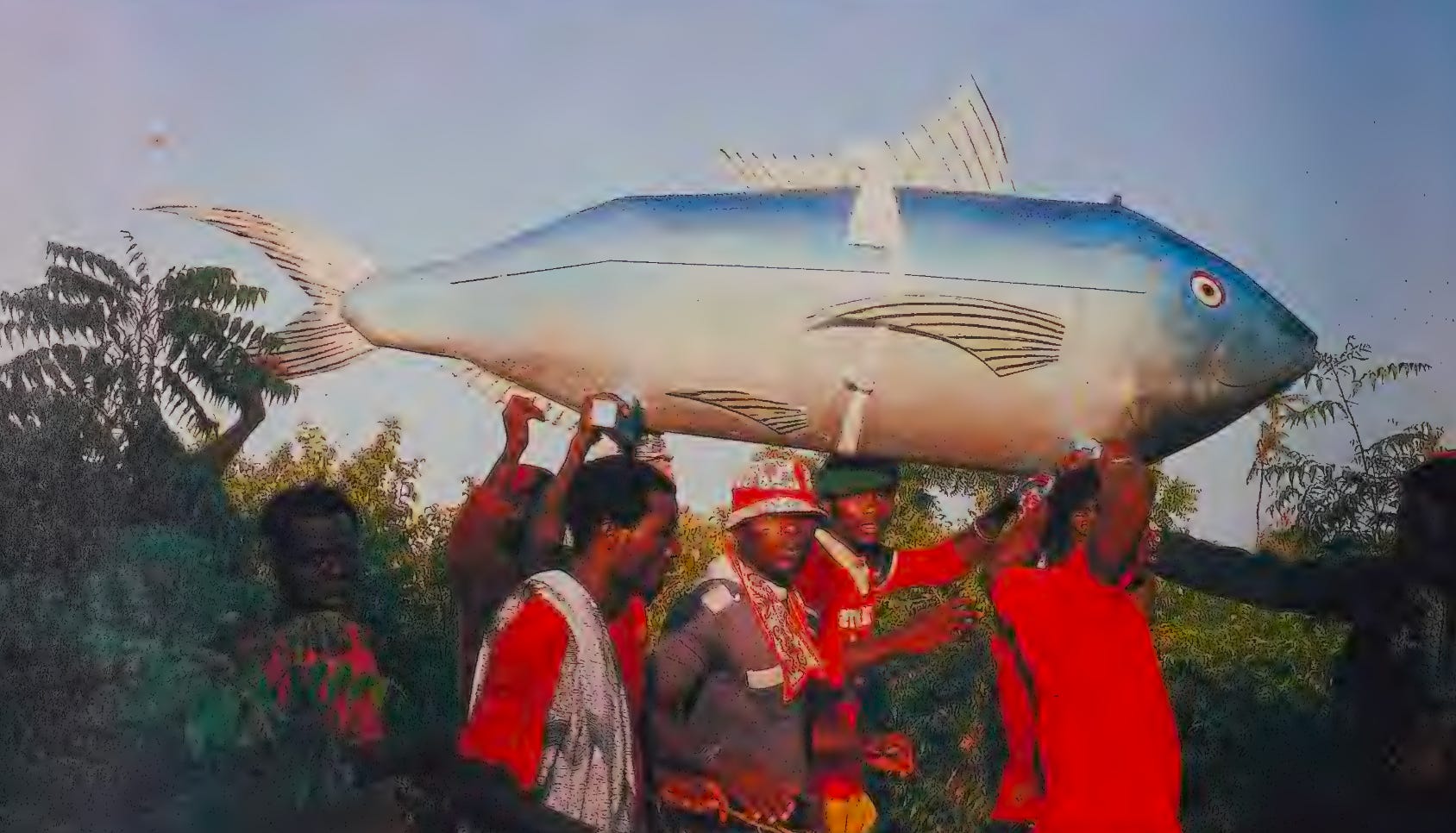
Sardine Coffin which buried a fisherman, photographed by Secretan Thierry in “Going into Darkness”
A “good death” is one that unfolds naturally and peacefully: at an old age, at home, surrounded by family, having fulfilled one’s social obligations and receiving the appropriate religious rites. Such a death affirms that the individual has completed the moral and social arc expected of them, making them eligible to become a benevolent ancestor who continues to watch over descendants. It is within this framework that fantasy coffins acquire their symbolic force. Far from extravagant displays of wealth, they function as carefully crafted vessels that communicate who the deceased is to the ancestral world. Whether shaped as a sardine for a fisherman, a cocoa pod for a farmer, the coffin becomes a final declaration of identity, dignity and belonging. In death, aspirations unrealised in life need not remain unfinished; the coffin completes the biography that earthly existence could not.
Conversely, the absence of such rites exposes a stark moral hierarchy embedded within death itself. Not every death grants entry into the ancestral realm. Deaths deemed sudden, violent or socially disruptive—including suicide, accidents and historically stigmatised illnesses such as HIV/AIDS — are often categorised as “bad deaths”, rendering the deceased spiritually unsettled and, in many communities, ineligible for full funerary ceremonies. Scholars like Van der Geest have argued that such individuals occupy a liminal position: neither fully integrated into the world of the living nor accepted among the ancestors, their spirits are believed to risk wandering or bringing misfortune upon surviving relatives. This distinction demonstrates that funerals in Ghana do more than commemorate the dead; they actively determine one’s social destiny after death. Religion further reinforces these expectations.
Whether expressed through Christianity, Islam or indigenous African spiritual beliefs, many Ghanaians regard life and death as governed by divine will, believing that healing, deliverance and even miraculous intervention remain possible until one’s final breath. Death therefore becomes not merely a biological event, but a spiritual and communal verdict upon a life completed or interrupted. Fantasy coffins thereby are only privileges reserved for those whose deaths affirm the continuity between earthly existence and ancestral life. The question is not simply whether one dies, but whether one dies in a manner that aligns with society’s grammar.
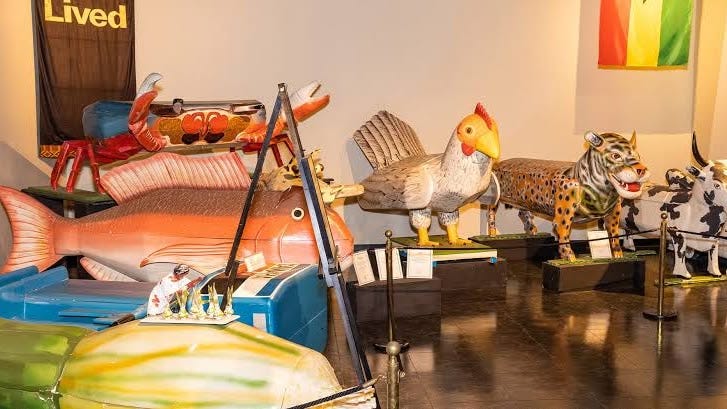
Collection of Fantasy Coffins
Comparison against other Death Rituals
The fantasy coffin becomes particularly illuminating when placed alongside other funerary traditions around the world, as it reveals that every society answers the same existential question, “What remains after death?” in different ways.
Across much of contemporary Western Europe and North America, funerals tend to emphasise remembrance over continuation. Coffins are deliberately understated, often simple wooden or polished caskets designed less to represent the individual than to respectfully contain the body before burial or cremation. Identity endures through photographs, spoken eulogies, engraved headstones and increasingly digital memorials. While these ceremonies celebrate a person’s life, they rarely suggest that the deceased requires material possessions or visible markers of identity in the afterlife. Rather, remembrance is directed toward those left behind. The body is buried from social life, while memory persists through curated narrative. The coffin, consequently, functions as a practical object rather than a symbolic extension of the self.

Chinese Columbarium in Kuala Lumpur
Across much of East Asia, another philosophy emerges. Influenced by Buddhism, Confucian ethics and longstanding ancestral traditions, cremation has become the predominant funerary practice in countries such as Japan, South Korea and increasingly parts of China and Southeast Asia. In this instance, the physical body is expected to return to its elemental form: quite literally, ashes to ashes. Permanence sought is not the preservation of bodily identity, but the continuation of familial relationships across generations. After cremation, ashes are placed within urns, family tombs or columbaria, while ancestral tablets occupy places of honour within homes or temples. The dead continue to participate in family life through seasonal rituals such as Qingming, Obon or Jesa, where descendants offer food, incense and prayers to reaffirm filial obligations and to ensure their stability in the afterlife. Identity survives because descendants continually remember and perform their responsibilities toward previous generations. In this sense, remembrance becomes an ongoing practice rather than a singular funeral event.
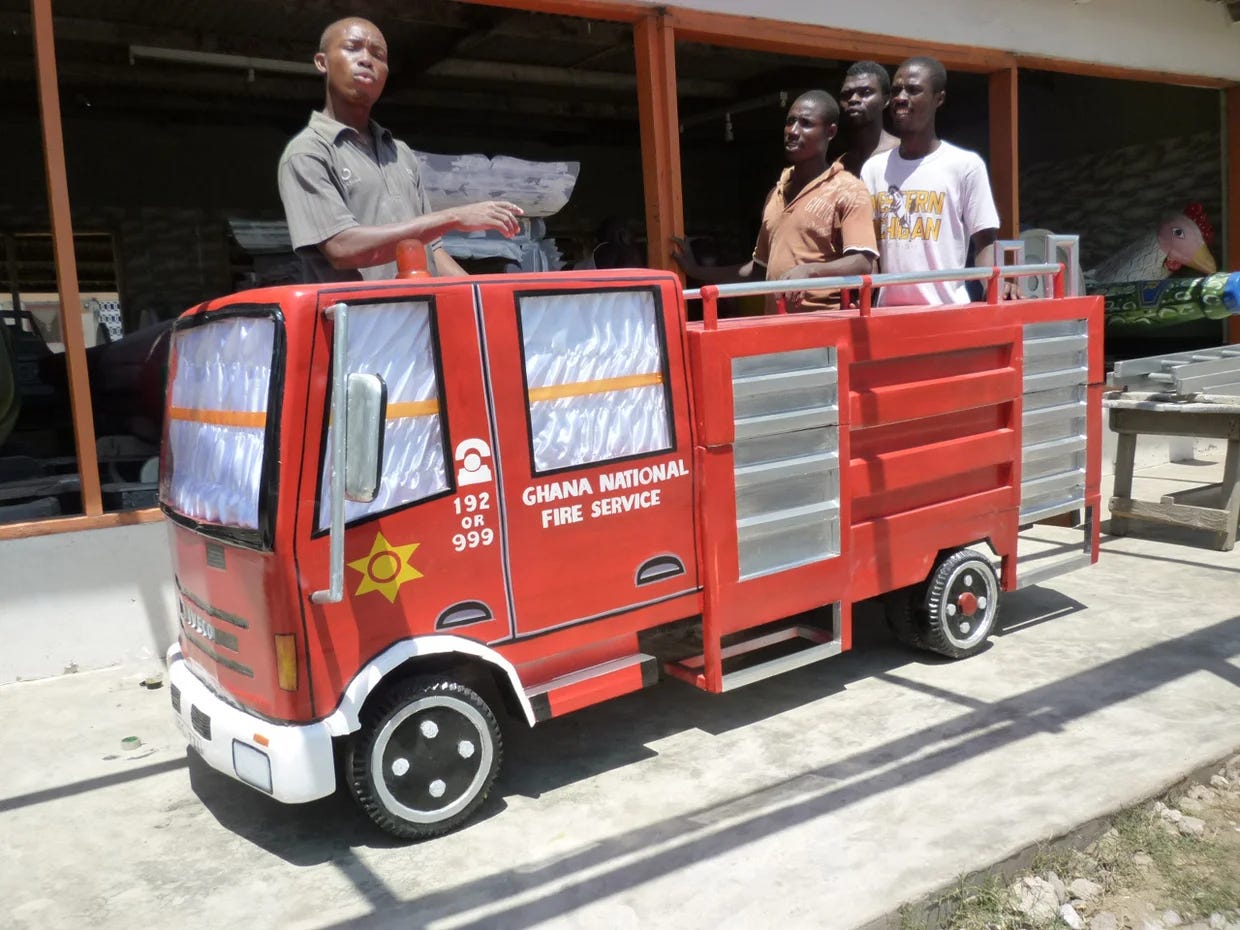
Artful Coffins of Ghana, by CBS News
The Ga tradition offers a striking alternative to both approaches. Unlike the Western tendency to preserve memory through stories, or the East Asian emphasis on lineage through ritual, fantasy coffins insist that individuality itself accompanies the deceased into the next world. The coffin is not merely an object of procession; it is a visual language through which one’s profession, achievements, aspirations and personality remain legible beyond death. In doing so, the fantasy coffin resists the universalising tendency of death itself. Where mortality threatens to reduce everyone to the same biological end, the Ga people proclaim that difference, identity and personal history continue to matter. Death, paradoxically, becomes one final opportunity for self-expression. The result is not simply an elaborate burial custom, but a radically different philosophy of personhood: one in which individuality is expected to survive, not despite death, but through it, and a celebration of life rather than an end in itself.
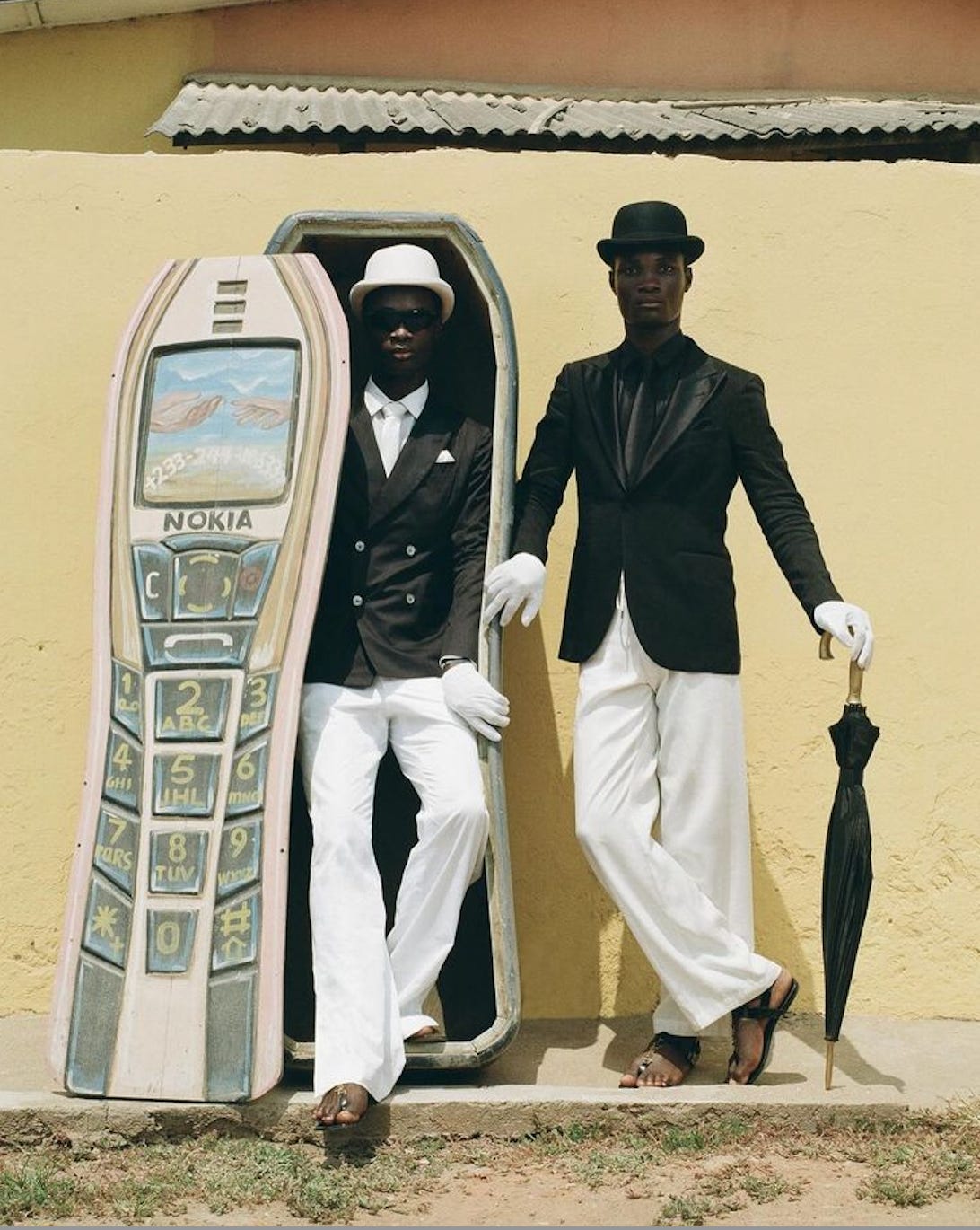
Le Dernier Voyage, photographed by Kenny Germé
Conclusion
Ultimately, the many ways societies care for their dead are less about death itself than about answering a timeless human question: What, if anything, survives us? The West often locates survival within memory, where photographs, gravestones and stories preserve the traces of a life once lived. Across much of East Asia, continuity resides in lineage, where repeated acts of ancestral veneration sustain relationships between generations long after the body has turned to ash. The Ga tradition, however, differs in imagining survival. Here, personhood remains socially affirmed in death, where one’s identity within society remains: the fantasy coffin becomes the final medium through which identity is recognised, affirmed and carried into asamando. What is ostensibly an eccentric artistic tradition illuminates a philosophy of existence.
By confronting mortality with colour, symbolism and imagination, the fantasy coffins of Ghana remind us that funerary rites are ultimately acts of cultural storytelling. They reveal not only how different societies bury their dead, but also how they define a life worth remembering, whose death is worth honouring and the hope that something recognisably human continues long after the funeral procession has passed.
i have never in my life stopped to consider this cultural trait. its so amazing how human beings have so many ways of handling life and death, and to create with it. very good article :)
That’s actually so rad. What an amazing way to honor someone