

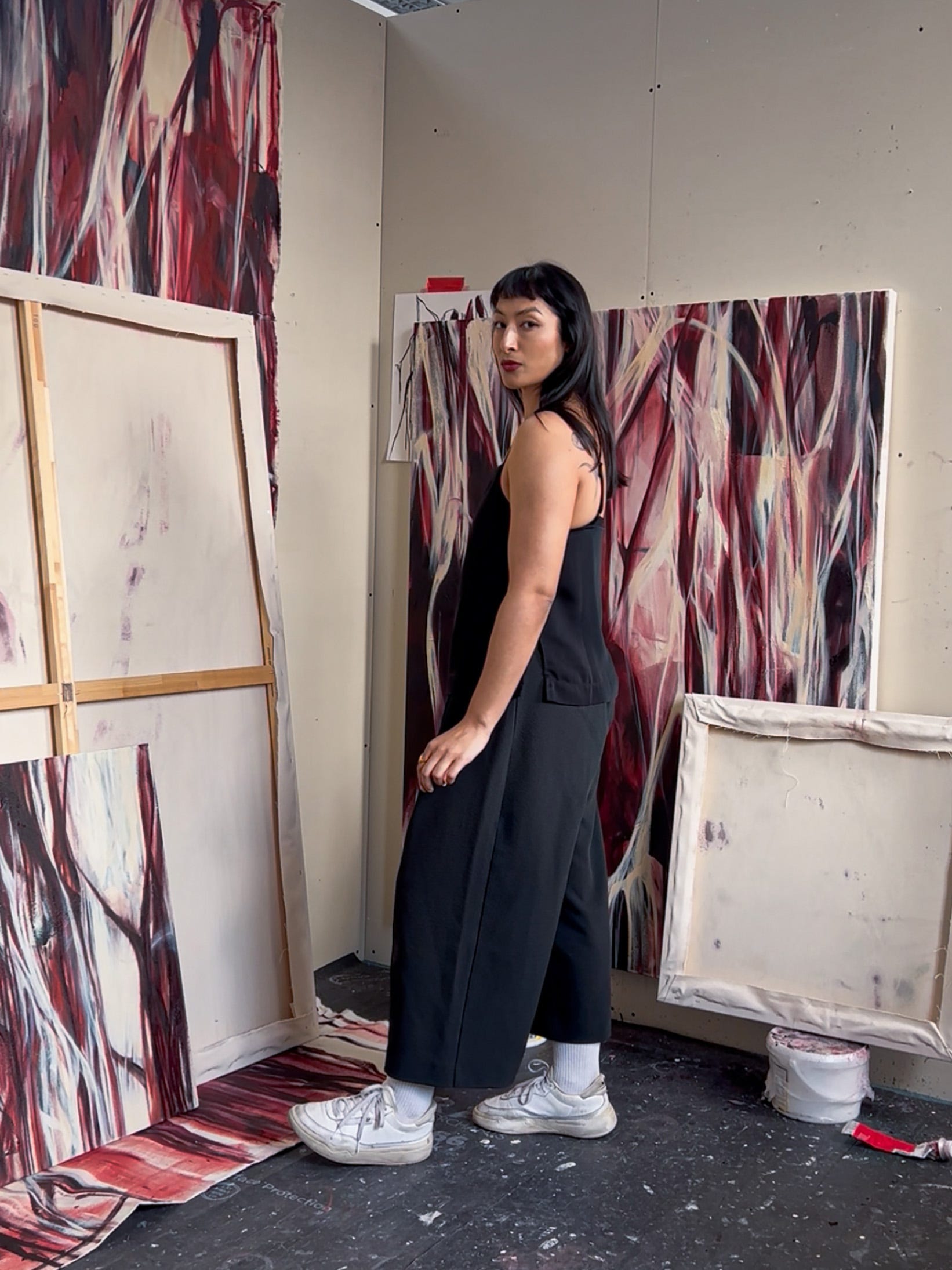
Artist Bio
Shumaiya Khan, b.1990 UK. Visual artist specialising in painting, sculpture and installation. BA from Goldsmiths University of London (2013) and MFA from City and Guilds of London School of Art (2025). Held residencies at London's Design District (2023-24) and Soho House (2022). Named one of 99 Future Blue Chip Artists by Artsted (2023), listed in Lucy Corban's (Girl & Gallery) 107 Female Artists You Need to Know in 2023 and Studio Blups' BLUP50 2022 cohort. Featured in The Sunday Times (2023), Spaces magazine (2023), The Art Bystander (2026) and Women in Art (2023, 2026). Exhibited at London Art Fair 2026 with Zarastro Art (Istanbul), Carta Magna (London, April 2026), auctioned at the Modern and Contemporary South Asian Art Department at Bonhams London (2026), 5050Collective, Paris (2026), 'TUFAN' at Whitechapel Gallery (July–September 2026) and Drawing Room, London (August–October 2026).
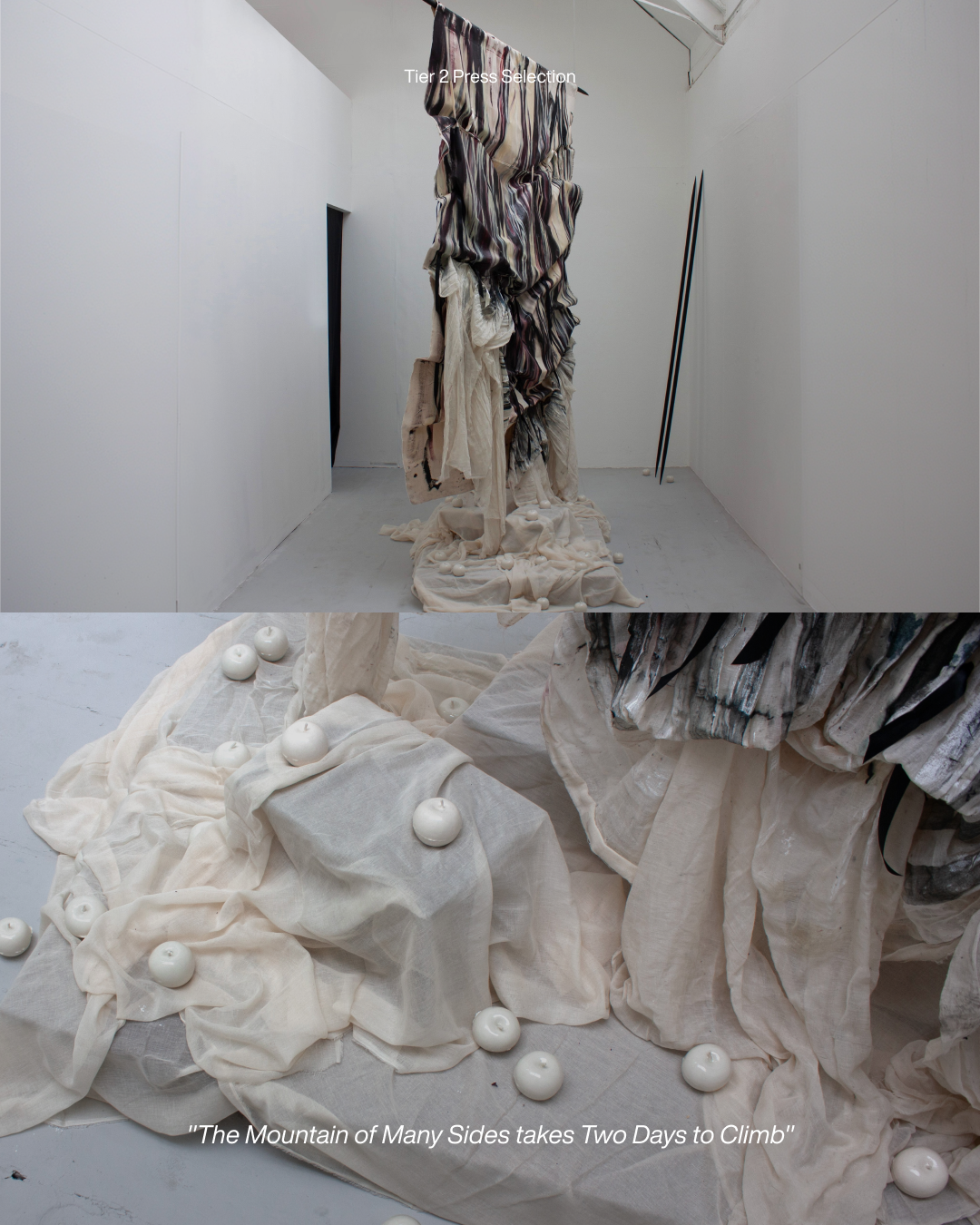
Your piece featured in the DUALITIES exhibition navigated complex tensions. Can you dissect the conceptual framework behind this specific work and how it responds to the exhibition’s overarching theme?
Even though I’m someone who doesn’t claim full autobiographical dialogue within my work, I understand that I’m partially present within my practice’s existence. Be this as a part of a collective conscience which drives broader metaphysical understanding pertaining to life, or that I can see how my life has taken on themes understood by so many around and before me.
The particular work which was featured in DUALITIES takes learnings from mythology, animism, the human body, divinity and mysticism. Each of these themes shows us that what we initially see isn’t always what is in front of us, causing a multitude of dualities.
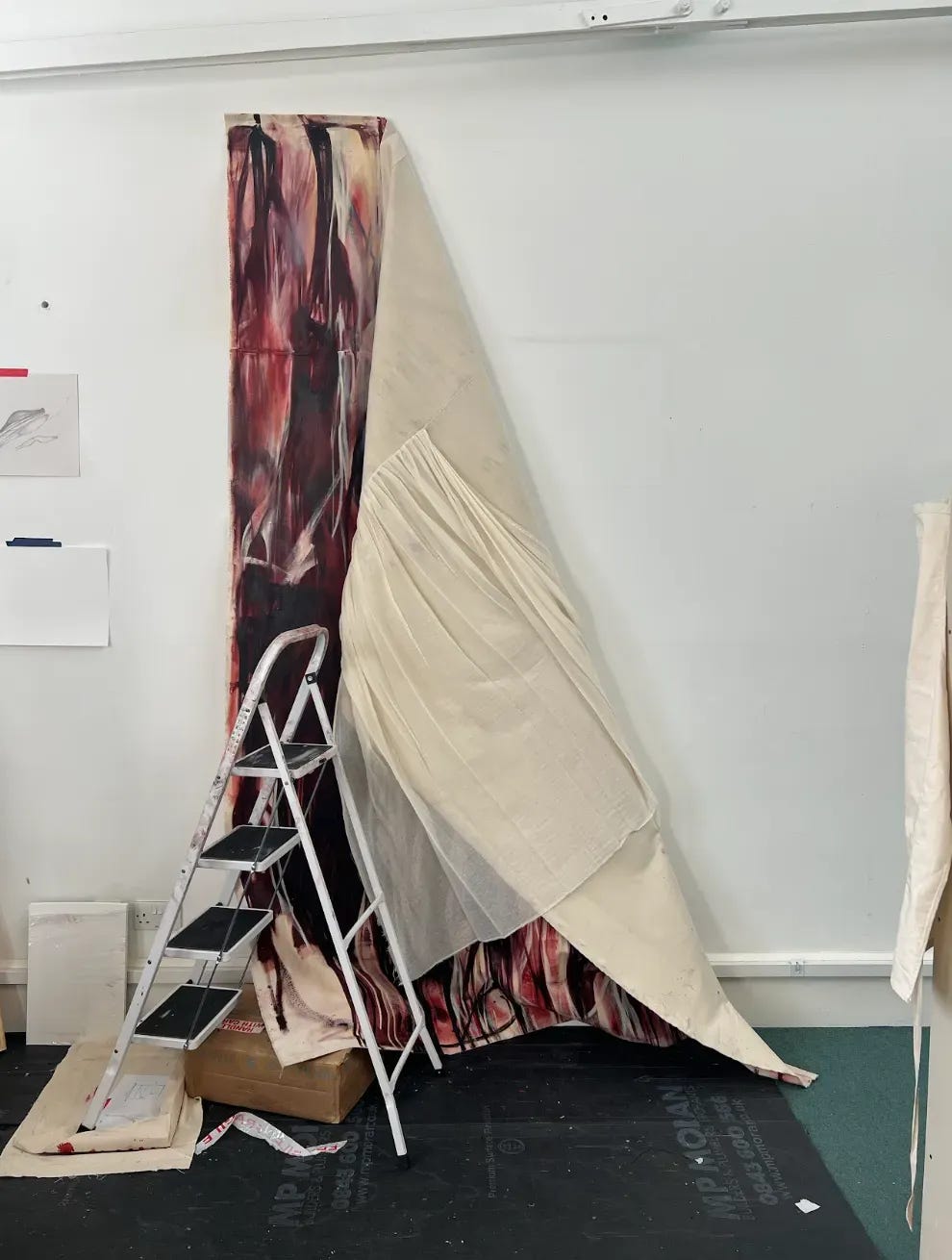
The Mountain of Many Sides Takes Two Days to Climb holds both a feeling of an internal world being built and subsequently exposed, as well as posing the audience with a number of choices on how to approach the work itself. In previous and current works where the internal bodily structure is warmer and fattier, Many Sides has a coldness to it, as though my own blood is not running through this work, separate from my own body, appearing as its own entity. A strong contextual reference for this work is the ancient tale of Inanna’s ascent up Mount Ebih: the challenge that greets her in her pursuit up this mountain, and how she ultimately succeeds. To win, she must draw on her learnings from her previous descent into the underworld. My work, as such, feels to be a record of mythic interpretation.
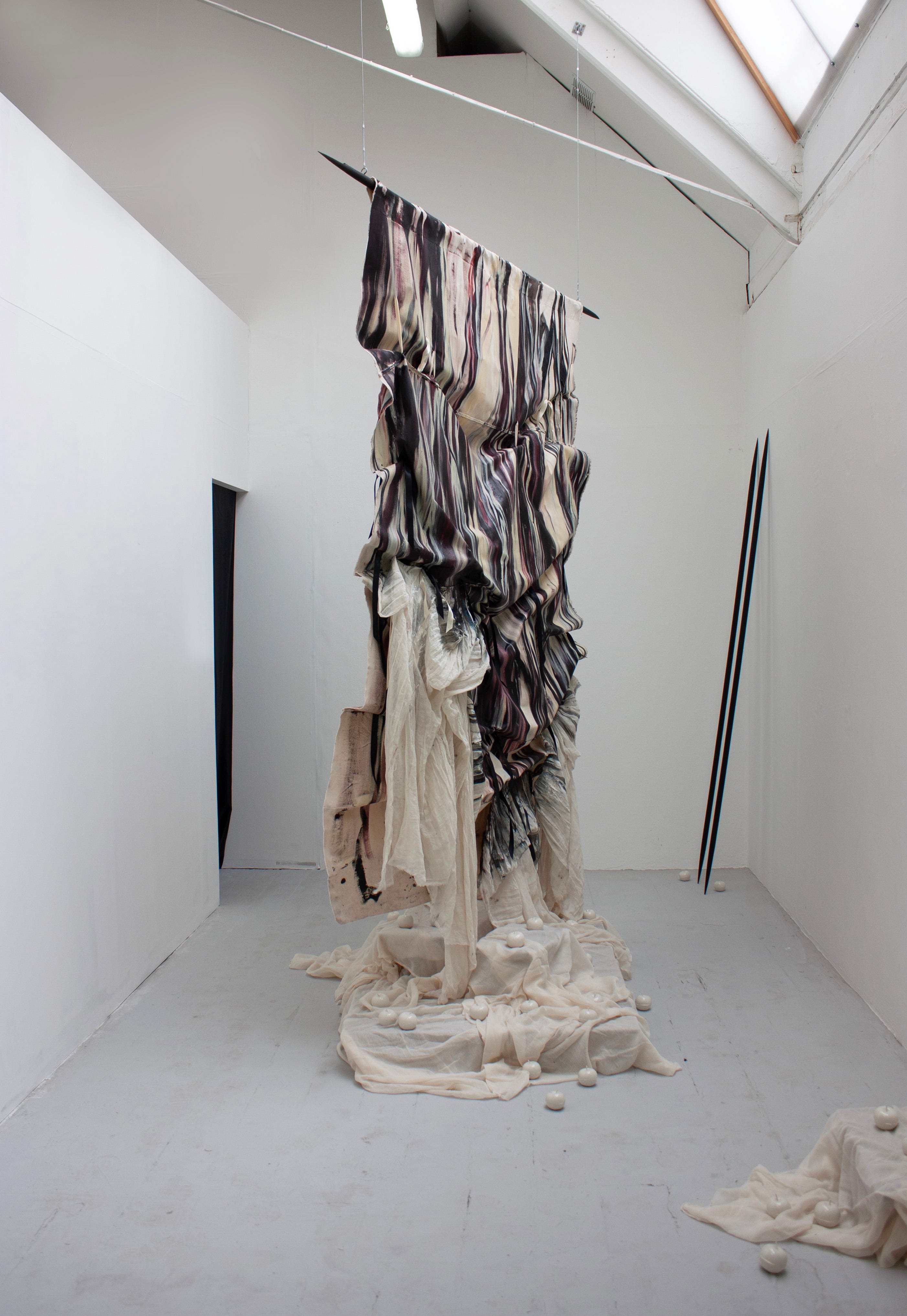
Installation/Painting/3D. Double-sided. Oil, salt, ribbon and cotton muslin drape on suspended, folded canvas. Hangs on Devonshire steel reinforced burnt birch spear. 240 x 340 x 25cm (inc support), 180 x 330 x25cm (main body). Installation shot shown with ‘Two of Wands’ (two spears at back) and ‘Seven Apples for Seven Heavens’ (porcelain apples on ground).
This work was created at a time when, for me personally, there was a push and pull between the internal and external environment/body. A metaphysical sensation of growing or pulling away from your skin, forming a new body, and learning how to inhabit this sacred space again. In some regards, the making of this work was the making of my own skin, and the coldness of the overall colour may be blood which has not yet been fed oxygen. The duality of life and death, oxygen and carbon, a root and a branch, muscle and stone, the body and the soul.
I could say all my work contains multitudes, or dialogues between states which extend beyond spoken language. I am drawn to an Islamic teaching that the physical body is tied to its metaphysical existence, and that for one to know themselves is to go inwards, release and build from within, which then is unveiled in a physical form. There’s also a deep belief that gnosis (knowledge) enters through the physical heart. This may point to my fascination with mythologies and quantum physics. I often wonder: in how many other forms, across billions of different perceptions, can we exist? I believe personally that all things, animate or otherwise, keep a record, and I often think about how this is portrayed through records such as artefacts, imagery, sound and the spoken word, through interaction.
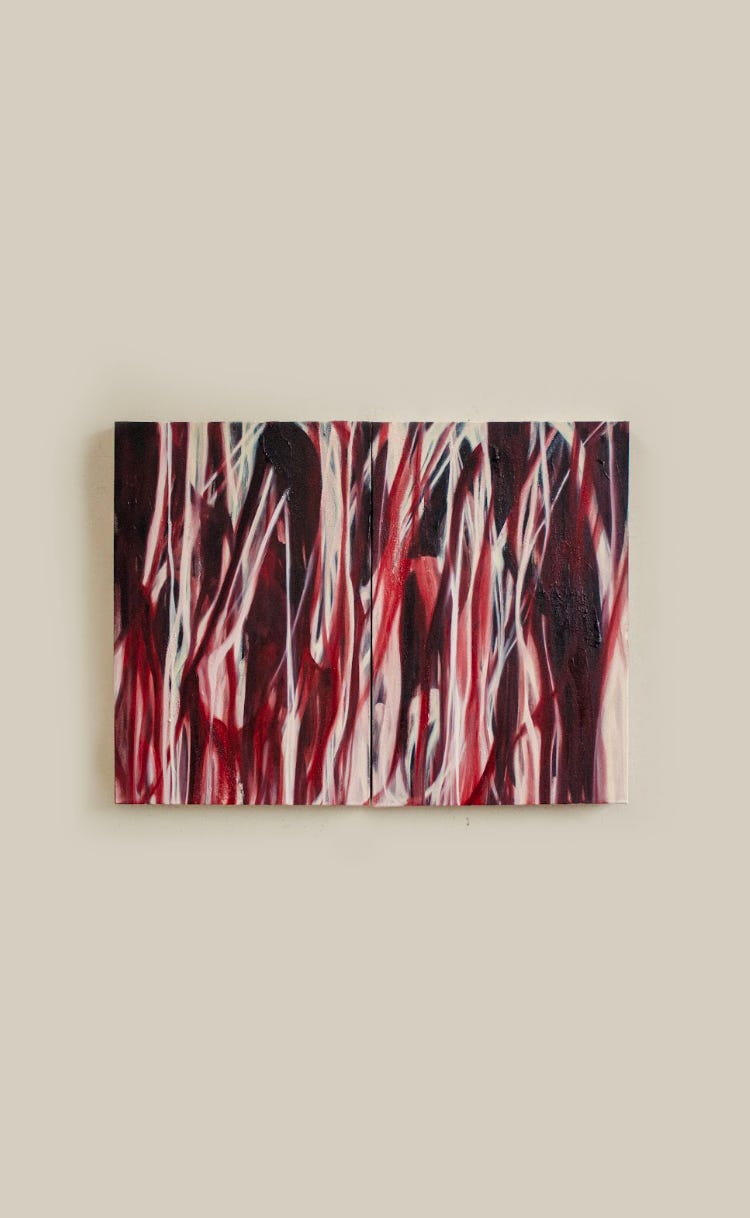
Shumaiya Khan, I made you with two hands.
The technical execution of your work requires a highly specific approach. Could you walk us through your methodology? How does your chosen medium and physical process actively reinforce your conceptual intent?
Whenever I’ve been given free rein to create something for a show, I tend to think about how I can expand the language of my practice. What I mean by this is where, or how, my recurring instinctual forms can continue to grow and live beyond more traditional substrate confines.
In 2025, I made this work for my MFA graduate show, knowing that folds, physical suspension, and a demand to explore the work from multiple angles were all physical requirements for my practice. This form in particular is double-sided, with multiple folds made possible by an excess of ribbon, which creates both physical and psychological tension. The work itself is held up by a burnished, steel-reinforced birch spear, allowing the work to become multidimensional and ‘stand’ by itself, alluding to existence as an entity, something or someone that can stand in the way of a mythic path. All my materials are naturally processed via pressure: the burning of spears, weaving of canvas, production of oil, and extraction and making of alloyed metals. If I’m going to make work about a metaphysical connection to an intense and concealed natural world, then all my materials must also have some contextual link to that same world.
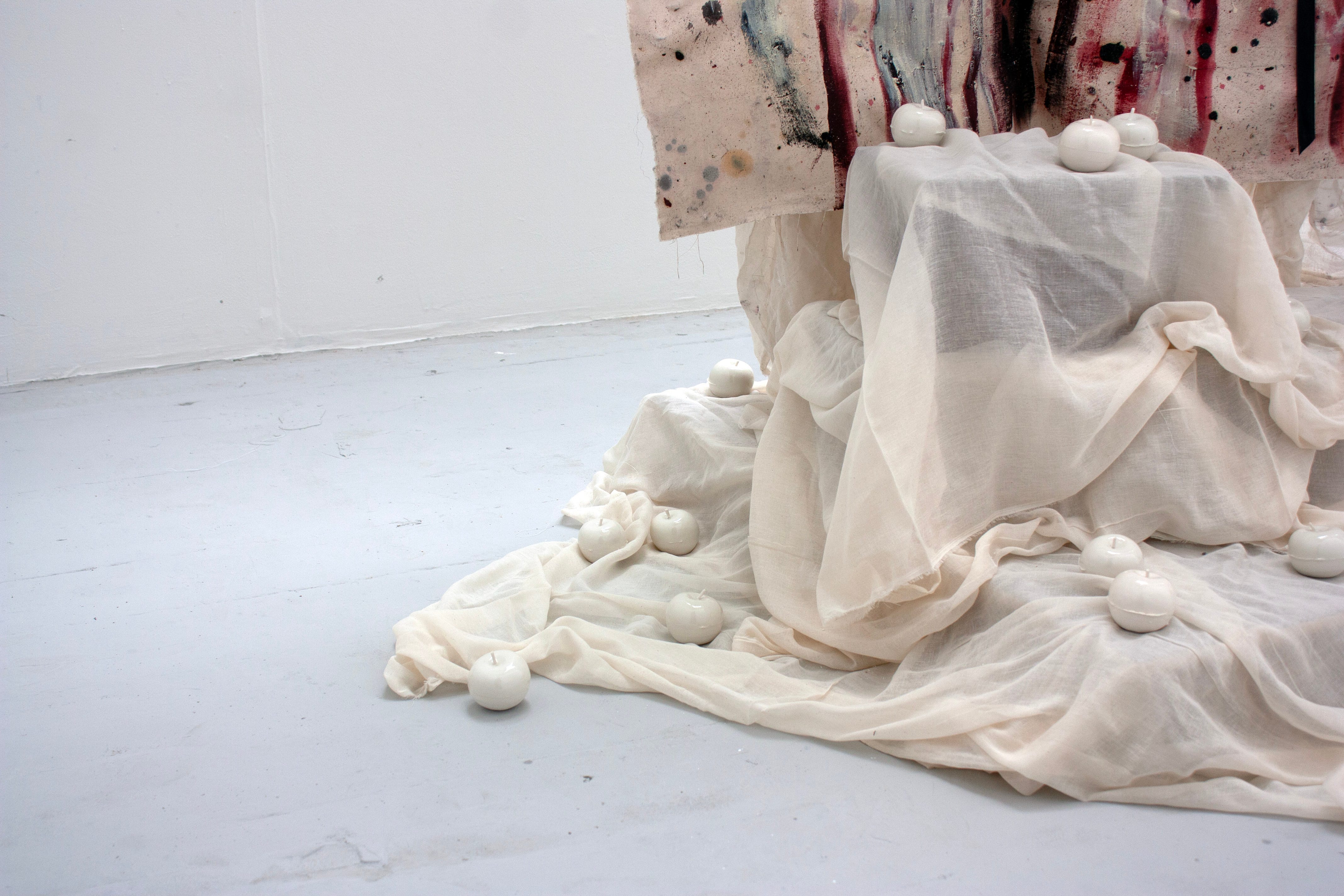
Shumaiya Khan. Seven Apples for Seven Heavens. Porcelain.
During this time (2024–25), I set myself the requirement of creating more immersive spaces by incorporating sculpture, which could stand on its own as standalone work, to build out installation spaces. As the year went on, my stretched substrate works began growing their own forms, which mimicked growing life, and this slowly intertwined with how the substrate the oil paint sat on could appear and be physically supported.
There was always a question of how my works physically interact with their space. For many of my wall- or ceiling-supported works, I had an obsession with the pieces connecting to the ground, to ensure the audience and the work itself share the same physical environment, so that an audience feels they can walk up to, or into, the work itself. This idea of shared space is linked to another contextual thread in my practice: the alchemical addition of salt in oil paint, as we humans also contain both fat (oil) and sodium (salt) within us, curating further the spaces both we and my works occupy. You could say this forms a mirror to how I see broader humanity residing within all our environments, or at least where I go often.
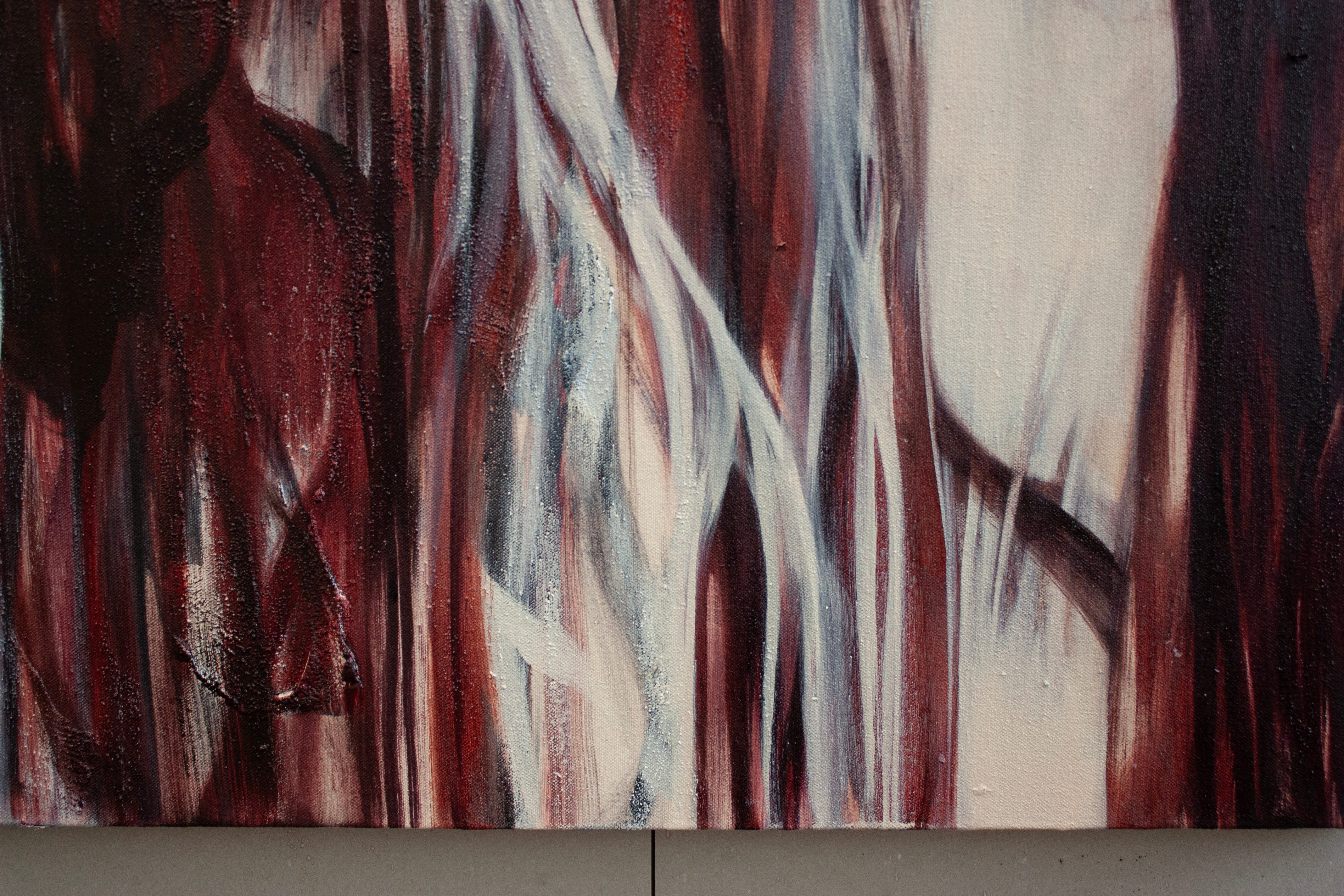
Shumaiya Khan. Flesh of the Palm, 2026.
In terms of how this particular work has influenced my current practice, the forms which appear in my work are slowly becoming more structured, layered deeper and less ‘immediate’. I see a lot of my work being built from a position of power and devotion to a divine force. That notion requires care and conviction.
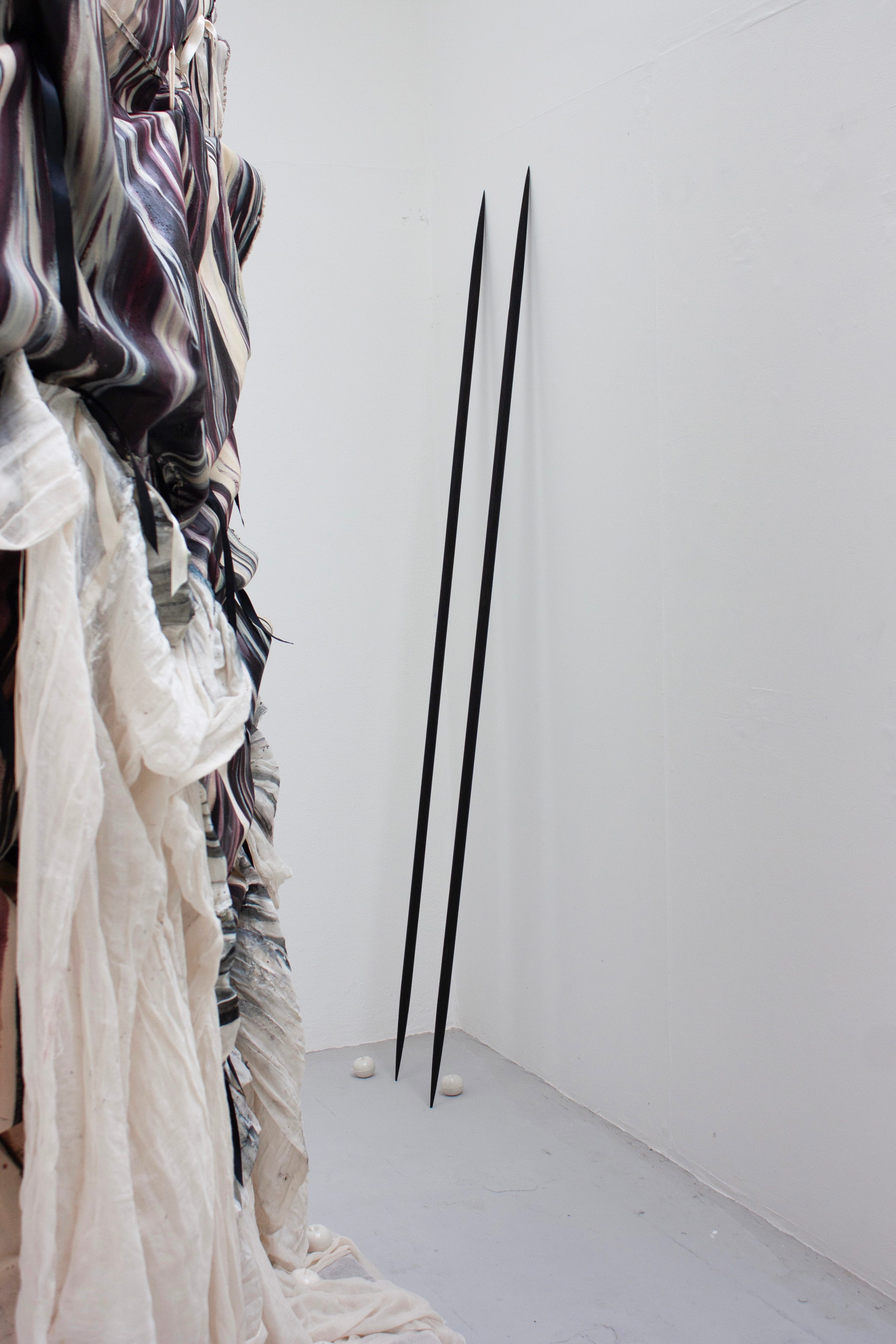
Shumaiya Khan. Two of Wands.
Much of your practice challenges traditional boundaries within contemporary art. How do you see your current body of work responding to, or perhaps disrupting, the current cultural landscape?
I read this question and laughed a little, because while yes, I understand my practice can challenge or trigger conversations and expressions that I feel a more comfortable, typically Western society doesn’t necessarily want to understand or entertain. I think something I’ve always aimed to do through my practice is to invite the act of creating to a point beyond what we initially thought was possible, or that we were capable of. What this particular expression could feel or look like, what it could bring out of ourselves, how we embrace the body, a soul’s alchemical journey, and even how we respond to intense colours and environments.
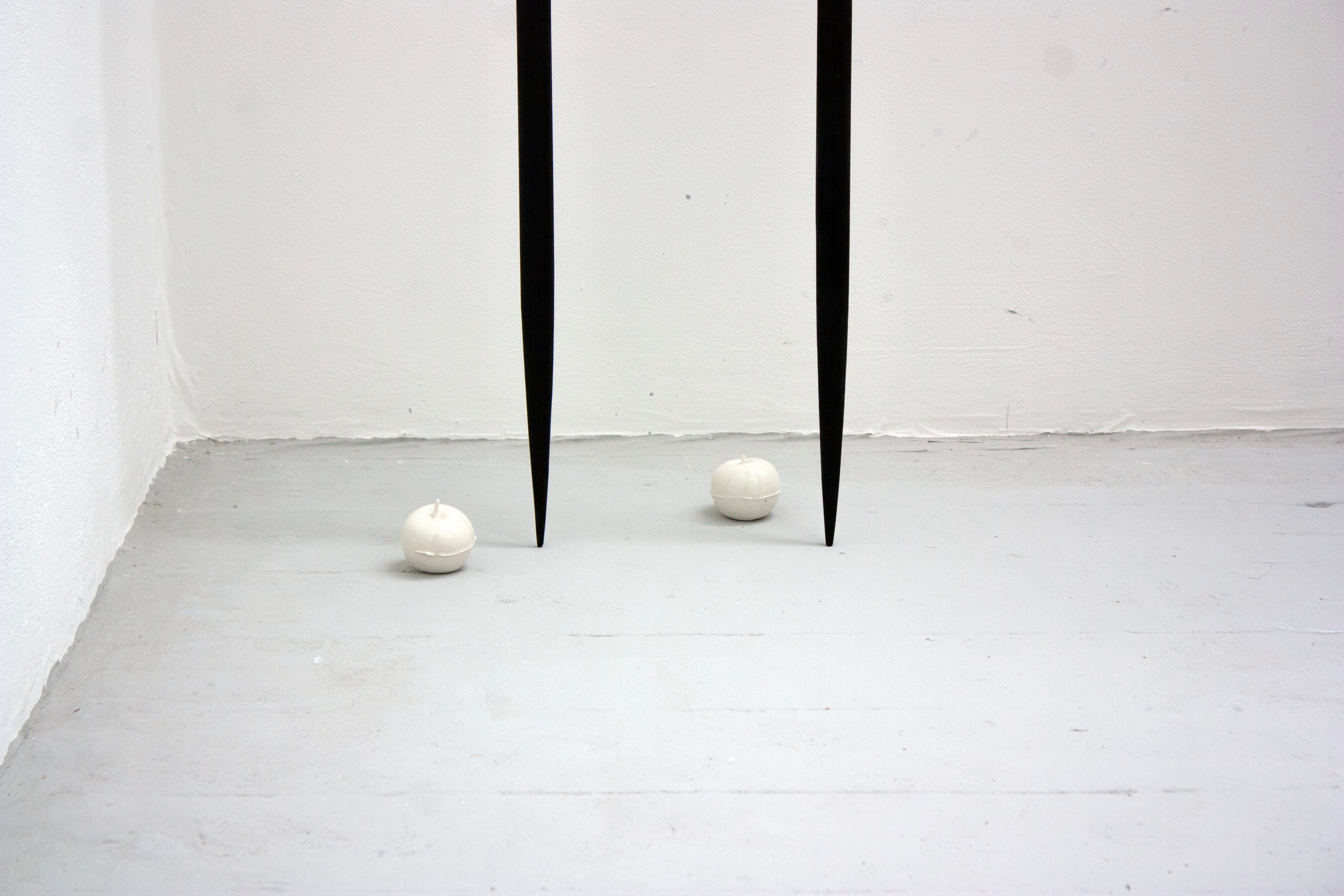
Shumaiya Khan. Two of Wands.
I’ve learnt, maybe I always knew, that my work, although abstract, is inherently political. My works carry a very active energy, made by an Asian diaspora woman who curates a spiritual passageway through her works. The forms and textures are visceral. Everything, although structured with intent, is a lot. There is an ever-present questioning of symbolism. These themes are not light.
In the age of capitalism, where value is placed on what can be bought or obtained, and people are tired, it can be overwhelming for some to engage with how they personally relate to broader philosophies. We have seen how capitalism, generally in the West, has tried to monopolise on spirituality, bypassing the lessons needed to obtain that peace and calm. So I understand fully if someone approaches my work and feels that the visceral energy within it translates to ‘trauma’ rather than ‘celebration of life’, because that very vocabulary is missing from how we are taught to engage with spiritual and mythic spaces in today’s society. It’s said that Western psychology doesn’t always work because it fails to initiate alchemical direction within oneself, so we relapse back into a hurt or trauma because that is the only part of the self we recognise. In alchemy, however, we’re taught to create from that healed space via restructuring and actualisation of a path, building worlds, i.e. something akin to Inanna’s conquering of Mount Ebih.
A good reference for me is Audre Lorde’s essay ‘Uses of the Erotic’. Lorde shares that eroticism exists at the centre of all women as a large creative reservoir, and can exist only for oneself. That the feeling and power of the erotic goes beyond what it has been limited to, i.e. sexuality, and is only activated when shared with or for another, mistaken for pornography and the performing of desire, rather than embodying the moment itself. Every time I create, in my fullest expression, joy, generosity, life and sensuality pour out, existing within their own right. To me, red is the colour of life and conviction. The colour of oxidised blood, iron ore, lava, heat. The fullest of things. I want to carry on making in my fullest.
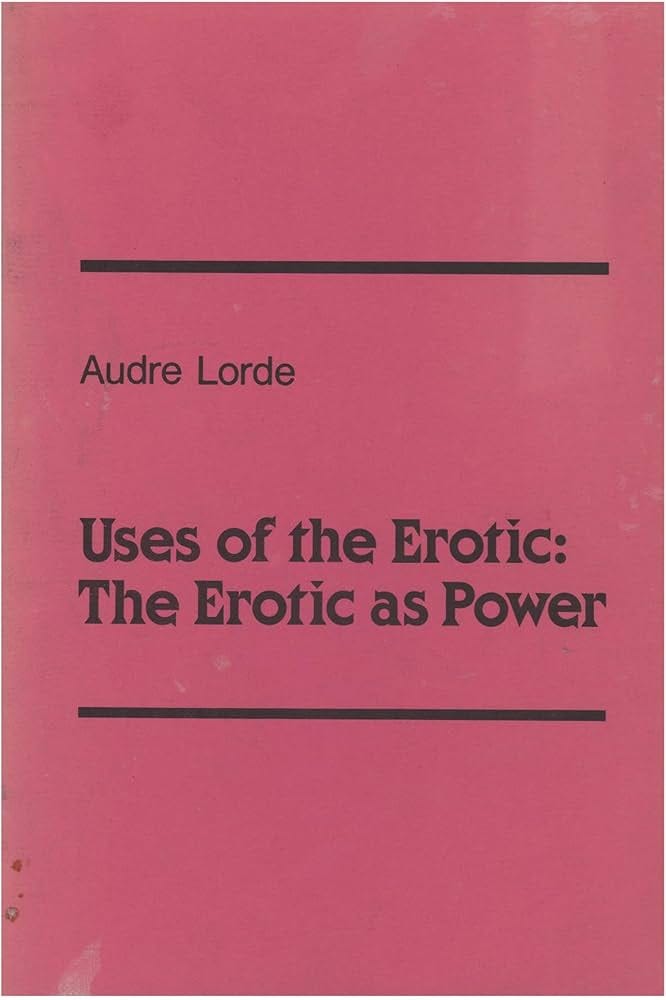
Uses of the Erotic: The Erotic as Power by Audre Lorde.
As an artist whose work is gaining critical international traction, how do you foresee your practice evolving next? Are there new mediums, scales, or theoretical territories you are preparing to explore?
Currently, I have work on show at Whitechapel Gallery and another on view at Drawing Room in London, August through October 2026, and previously auctioned work at Bonhams South Asia. Off the back of this current institutional direction, I’m aiming to continue working with other institutions and ambitious commercial spaces (curators/galleries) to realise more ambitious, research-driven projects. Not only do I paint and sculpt, but I also write, a practice I’ve taken a break from for the past few months while I research and focus on making more physical work.
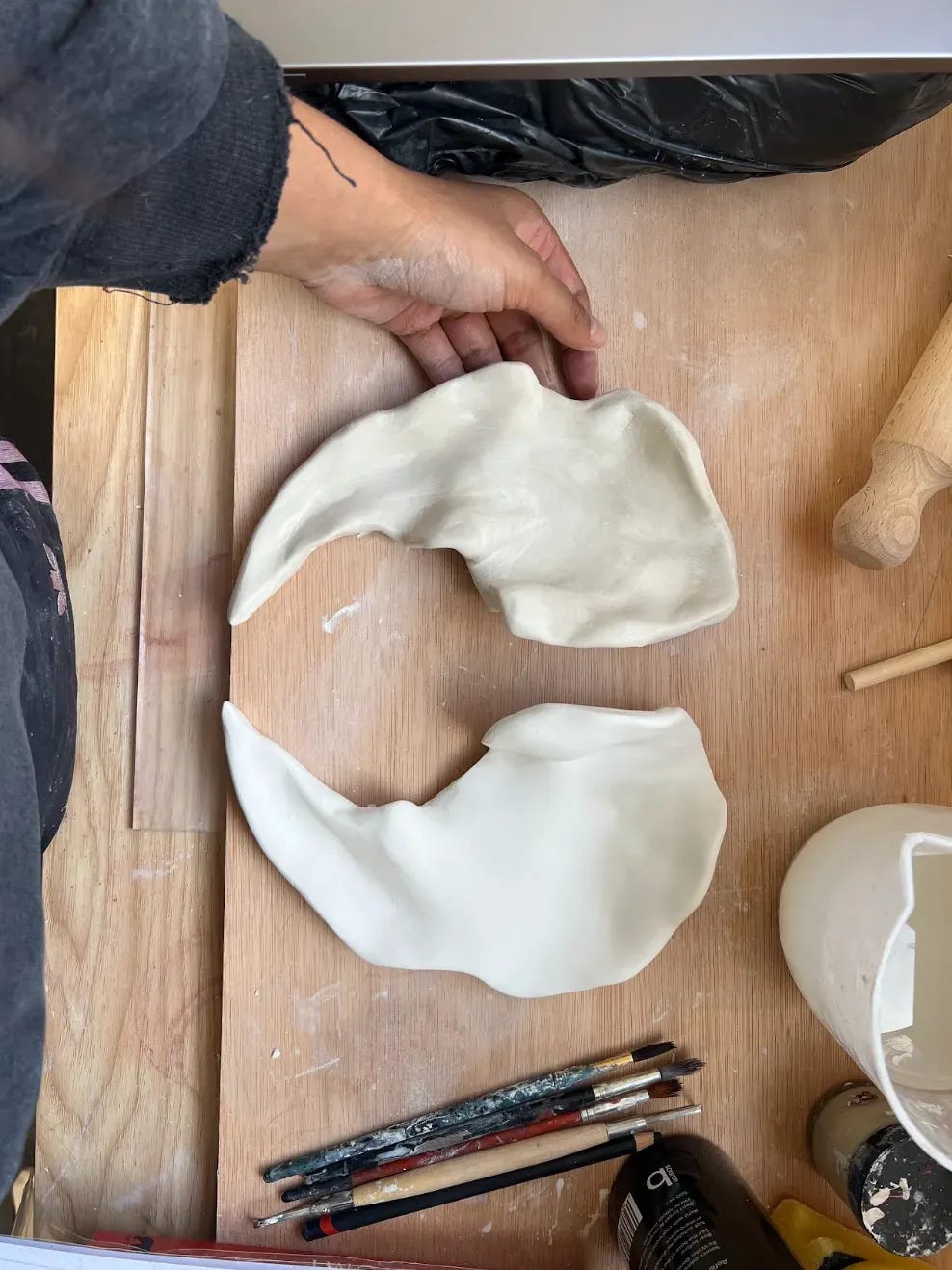
Whether or not I have the ideal settings, I want to keep creating larger installations, consisting of multiple separate works which come together to create their own, and/or echo established, mythologies. I’m currently making a series of porcelain objects which connect to the human body and plants, and starting on a few more multi-panelled and loose suspended works. In terms of scale, I think each individual work will tell me what scale it needs to be made at. Recently I’ve started enjoying making smaller works alongside massive pieces. There’s something really intimate and solitary about these works, which play off my really big 3m paintings.
I do see myself creating immersive environments, working with others across different, typically analogue, mediums. I’m hoping to embark on a few residencies in the near future, hopefully in Asia and southern Europe, to explore spiritual and mythic histories, in particular spiritual resonance in plants, and how this echoes out in society today: what stories remain true, and how this feeds into art and other things we consume. I have scheduled time to write and make a small, limited-edition book reflecting where my practice is at the moment, with an estimated release by the end of this year. I may turn this into a bi-annual record for myself.