

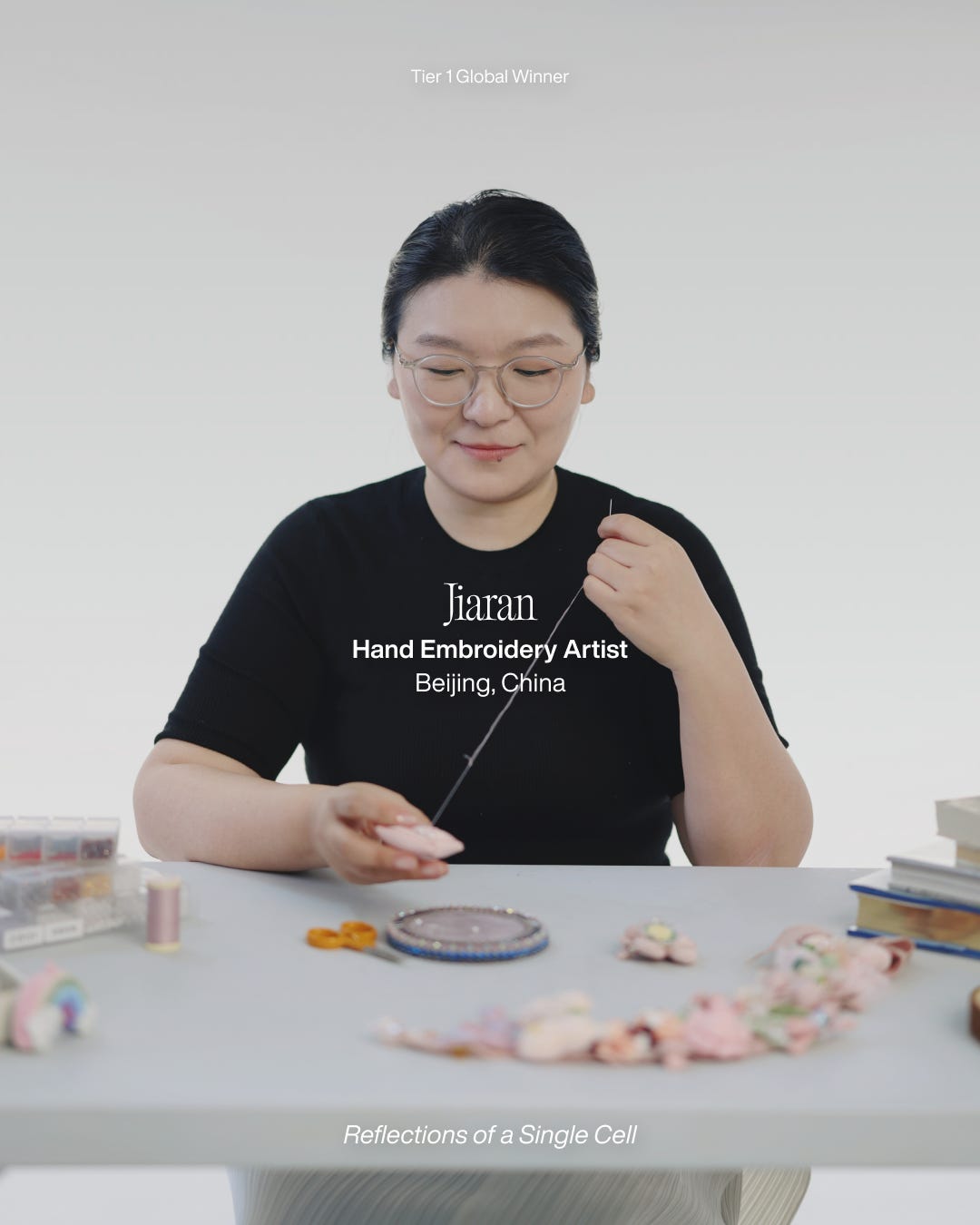
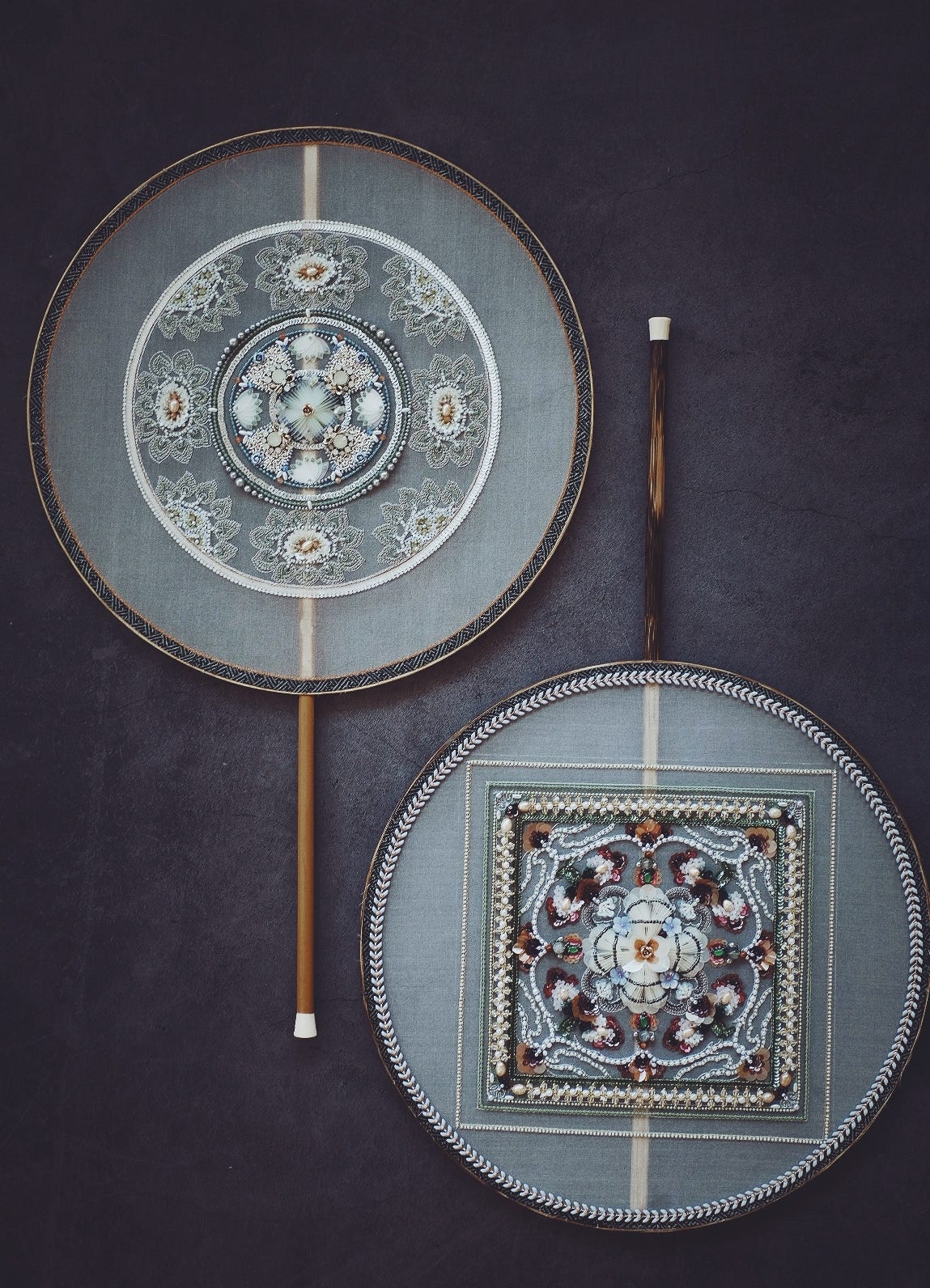
Jiaran works in embroidery, specifically Dunhuang-themed caisson-pattern Tuanshan, Chinese round fans built from beads, silk thread, and crystal. Her practice sits at the meeting point of East and West, tradition and reinvention, patience and instinct. What follows is her response to our interview questions in full.
Q: If you had to name a single theme, proposition, or persistent curiosity that keeps driving your creative work, what would it be?
A: I’m curious to see, as my mindset shifts and my thinking on life deepens, what state my work might eventually reach.
Over more than a decade of creative work, I’ve made over a hundred Dunhuang-themed caisson-pattern Tuanshan. I went from the smug satisfaction of finishing a simple Tuanshan in a day, to the deep contentment I feel now after months of deliberation over a single piece. Within a few inches of space, there’s endless transformation, unfinished threads of thought, themes that embroidery can never exhaust.
As an embroidery artist, I shouldn’t simply remain in the present. Instead, I should fold the techniques I’ve encountered into this era, push forward how embroidery is expressed and shared, and explore more of what embroidery can become.
To me, embroidery is like a diary. It records the growth of a woman obsessed with this craft, examined from a third-person perspective, a state of selflessness. Of course, I’d love to flip ahead to the final page and see how the story ends. But embroidery has taught me to wait patiently, to wait quietly for the flowers to bloom.
Q: Is there a question you keep circling back to through different pieces of work, without ever fully answering it?
A: Mending and stitching shut the rift in how East and West understand embroidery, building bridges with needle and thread so that, without a single word, you can grasp what I’m trying to convey in an instant. Eastern and Western aesthetics have long shaped one another, and in the process of creating, I’m searching for that fusion, transforming the unfamiliar or the deeply ingrained into a beauty that knows no borders. Of course, this is a question I still can’t fully answer today, because I’m stumbling and feeling my way through the exploration myself.
Q: What is the relationship between the medium you choose and the content you want to express?
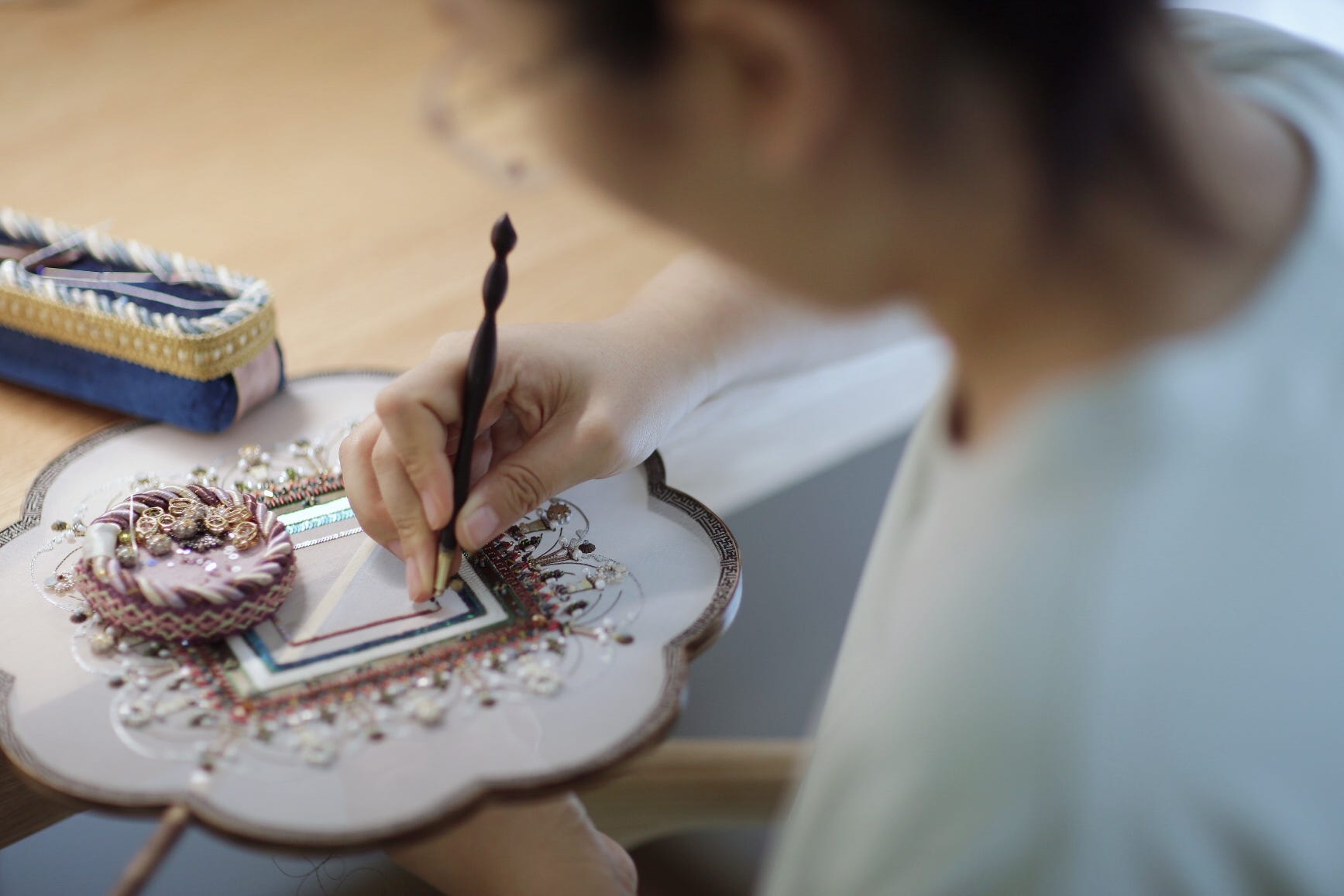
A: A lot of people think of medium as simply material, the beads, silk threads, crystals, Tuanshan I choose are all just “tools” in that sense. But to me, the medium is an interpreter standing between embroidery and myself, telling the world that embroidery can speak this way too.
Q: During the creative process, how does the actual hands-on work of making, adjusting, and experimenting help translate the ideas in your head into a finished piece?
In every moment of joy, anger, sorrow, or longing, I step outside of it and let embroidery do the translating.
I don’t think with my mind, I test with my hands. The length of every stitch, the direction of every bead, the way different materials come together, all of it starts from the heart, a pure expression of the self beneath the self. Sometimes I’ll just stare at a blank piece of fabric, and I can see what it’s going to become. The basic lines flash before my eyes in an instant, and once I trace them, something unexpectedly delightful emerges.
I love this process. It lets me work more freely, not just chasing what’s beautiful. Of course, the process is never smooth sailing either. It usually comes with tearing things apart and rethinking them, but the direction never changes. Every time I pick up the needle, it’s a revision and a rebirth of the idea itself.
A: This exhibition is themed Dualities. In your everyday creative work, how do states like opposition, contradiction, balance, and tension show up? Do they shape the way you work, how you think, or how you understand the world?
These days, when I start a piece, the starting point is never “I want to simply combine two techniques.” It’s not endless competition, and it’s not what people now call “lying flat” either. It’s having a goal and moving toward it.
If art became like a competitive sport, it would represent opposition between people. What makes art compelling is precisely that you can appreciate the work purely for what it is, with no concept of winning or losing. When art-making is driven by self-interest, it fills with distracting noise, that pull of wanting this and also wanting that, and it’s all too easy to drain your own talent dry that way.
Staying clear-headed and aware, this is what Wang Yangming meant when he said: it’s easy to defeat the bandits in the mountains, hard to defeat the bandit in one’s own heart. My attention gets pulled back to this again and again throughout the day, because there’s a wish living in my heart, to leave more beautiful embroidery work behind for this world.
When people from outside question whether I’m not traditional enough, nothing I do is about standing in the West to challenge the East, or standing in tradition to resist the contemporary. I’m simply standing on my own heart, putting the needle in honestly, recording how embroidery is changing in this era, leaving behind, like so many artists before me who are now gone, a trace of beauty for this world. Harmony is what matters most. Once you hold to that, opposition, contradiction, balance, and tension all settle back toward a kind of mean. Create from a peaceful state of mind, and whatever results follow will be beautiful, just like embroidery itself.
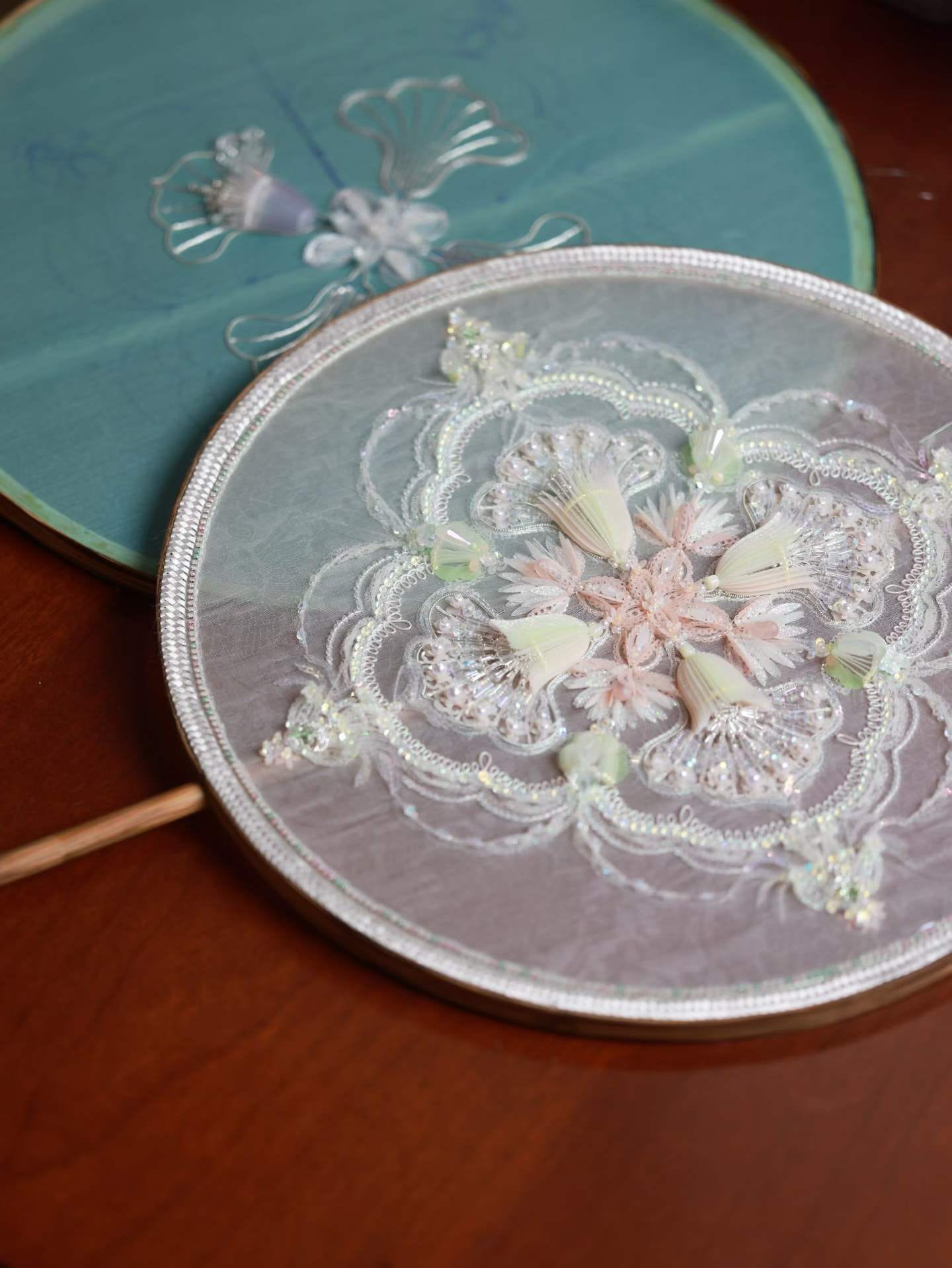
Q: When a viewer stands in front of your work for the first time, what do you most want them to feel? Some kind of emotion, a new way of seeing, a question, or a shift in understanding? If only one moment could stay with them, what would you want that moment to be?
I hope that as they look at my embroidery, they can also feel the love I hold in my heart for it. Patience paired with awareness, a state of being that’s resilient and optimistic. To wake yourself up, no matter how rough the road has been, there’s still, deep inside, a longing for beauty. If you can stand in front of my work and feel curious, or feel like you can’t wait to share it with a friend, then that seed of beauty has already taken root and sprouted in your heart.