

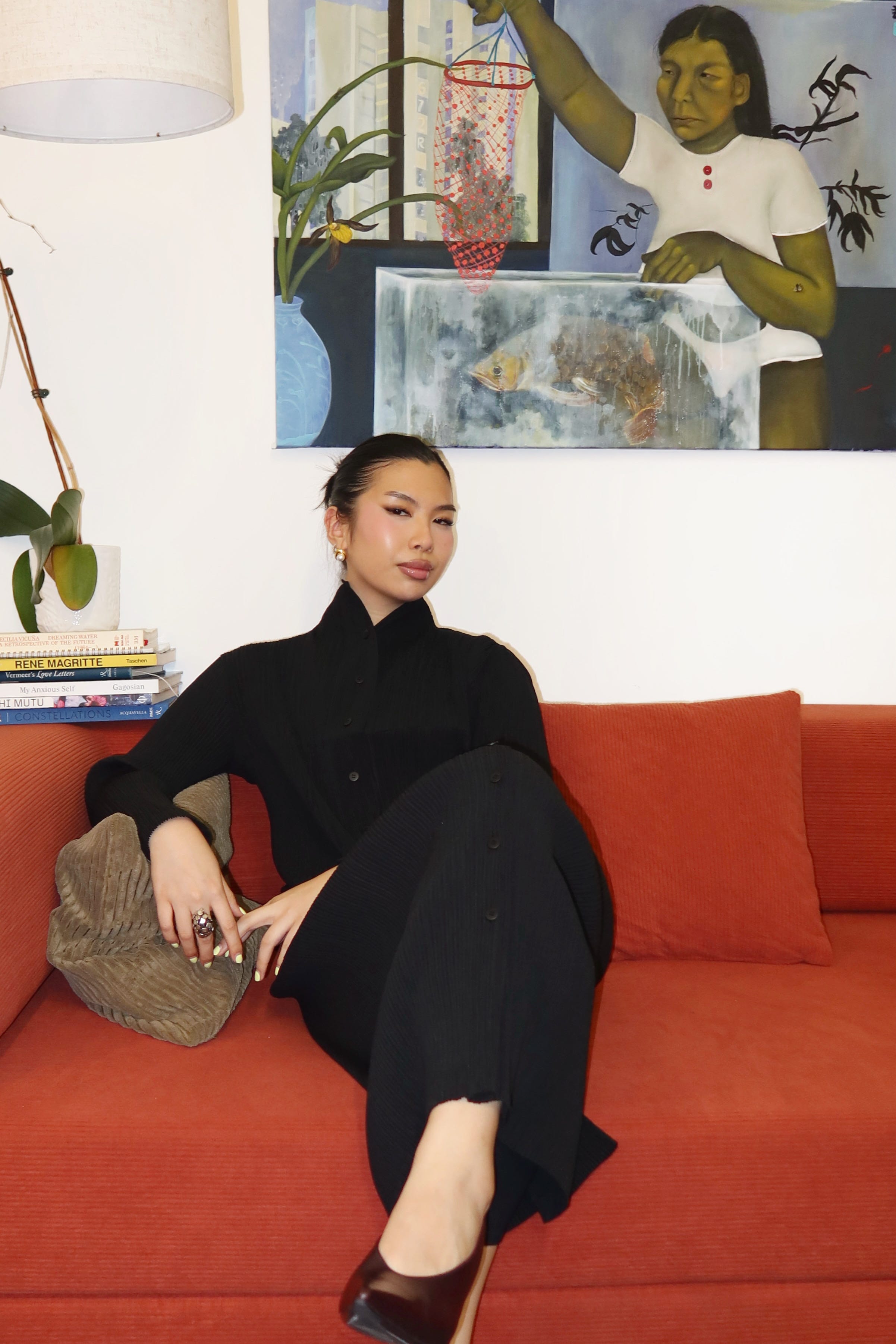
Artist Bio
Claudia Koh (b. 1999, Singapore) is a painter whose practice explores the relationship between human experience, the built environment, and the ecosystems that emerge between them. Drawing inspiration from urban landscapes, domestic spaces, and cultivated environments, her work reflects on the ways individuals navigate structures that simultaneously nurture, organize, and constrain everyday life.
Raised in Singapore, a young city shaped by careful planning and continual cultivation, Koh is interested in the tensions between nature and control, intimacy and regulation, and individuality and collective belonging. Through imagined environments that blend architecture, landscape, and domestic life, she examines themes of resilience, care, and coexistence.
Your piece featured in the DUALITIES exhibition navigated complex tensions. Can you dissect the conceptual framework behind this specific work and how it responds to the exhibition’s overarching theme?
In The Magician, duality emerges through the relationship between the human subject and the fish, two beings inhabiting parallel yet distinct ecosystems within the dense urban fabric of Singapore. Rather than existing as separate entities, they become reflections of one another, each negotiating containment, adaptation, and the search for connection within carefully constructed environments. The human figure embodies conscious introspection, while the fish moves through instinct and repetition, together revealing different expressions of the same condition.
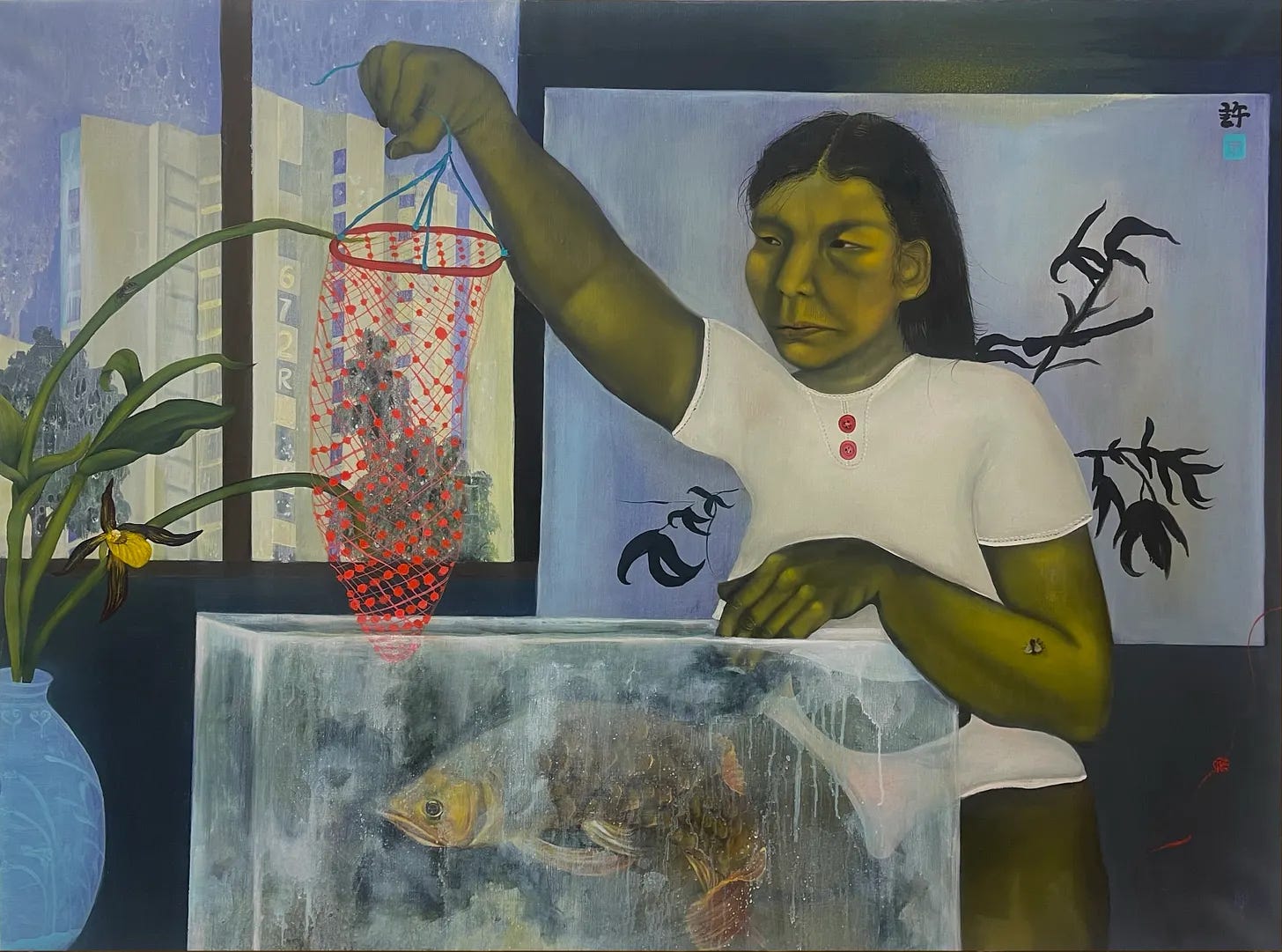
Claudia Koh. The Magician, 2026. Oil on canvas, 120 x 100 cm.
The aquarium and the apartment function as parallel architectures of enclosure, blurring the boundaries between sanctuary and confinement, observer and observed, freedom and restriction. These spaces mirror Singapore’s highly planned urban landscape, where systems designed to provide stability and collective life can also shape experiences of isolation and intimacy.
Responding to the exhibition’s theme of Dualities, The Magician proposes that opposing states rarely exist in isolation. Instead, they coexist and continually inform one another. The work suggests that visibility and solitude, care and control, autonomy and dependence are not fixed opposites, but interconnected conditions that define contemporary urban life. Through this quiet dialogue between human and nonhuman life, the painting reflects on how companionship and belonging emerge within environments structured by both support and constraint.
The technical execution of your work requires a highly specific approach. Could you walk us through your methodology? How does your chosen medium and physical process actively reinforce your conceptual intent?
My process always begins with observation. I collect fragments from everyday life in Singapore, from the geometry of public housing and cultivated landscapes to domestic interiors and fleeting interactions between people and their surroundings. I am also drawn to the quiet visual language of Singaporean Chinese homes, where customs, rituals, and everyday objects express an aesthetic of restraint, order, and care. Rather than documenting these places directly, I reconstruct them into imagined environments that feel psychologically familiar rather than geographically specific.
The paintings evolve slowly through layers of oil paint, where I build, erase, and revise the image over time. I think of this process as mirroring the way cities and ecosystems develop through continual adaptation rather than fixed outcomes. The composition is carefully structured, but I leave room for intuition and unexpected relationships to emerge as the work progresses.
Materially, I am interested in balancing precision with softness. Architectural forms establish a sense of order, while fluid passages of paint allow nature and human presence to interrupt that structure. This tension between control and organic growth reinforces the conceptual framework of my practice, where environments simultaneously support and constrain those who inhabit them.
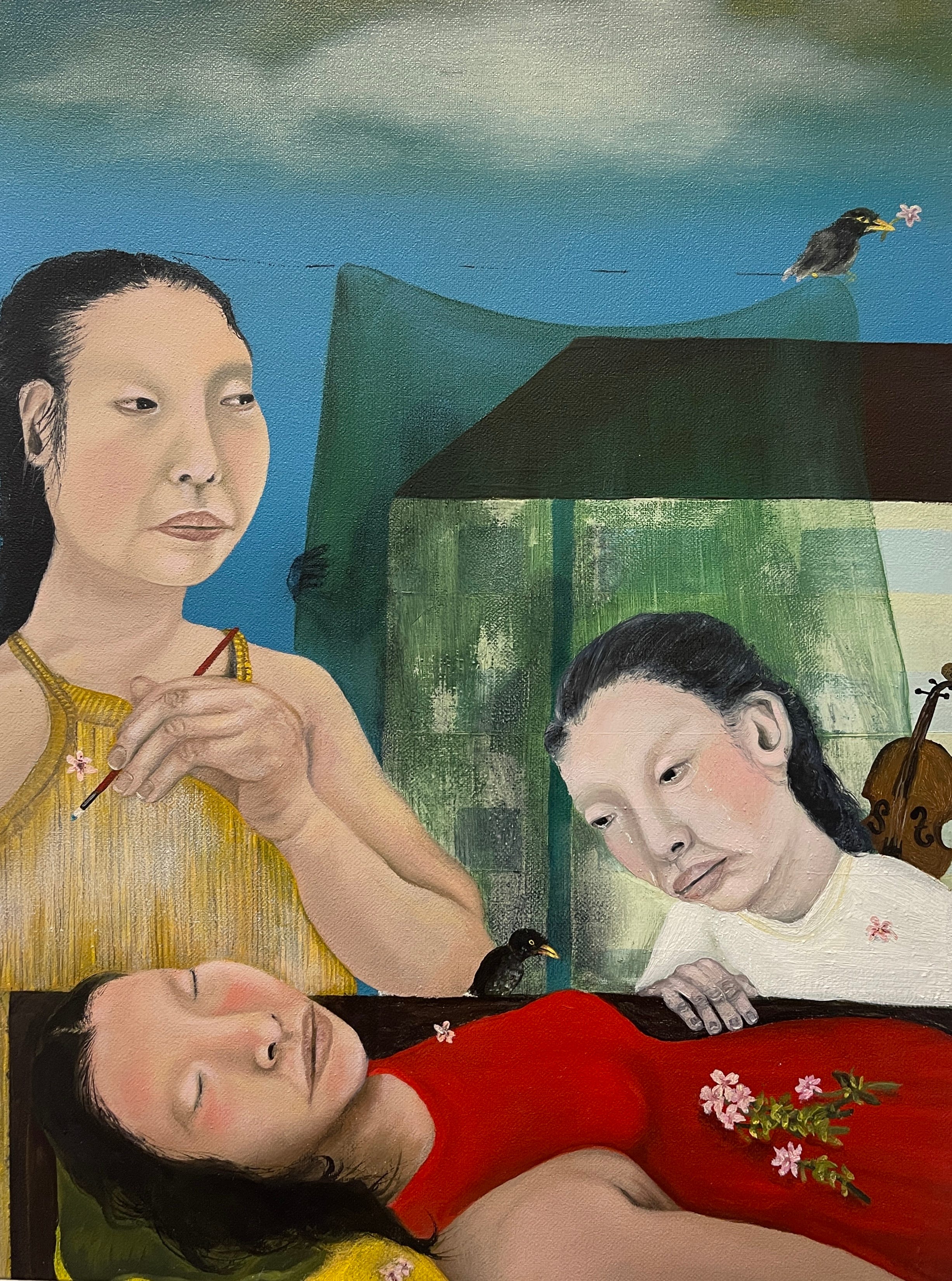
Claudia Koh. Finale, 2026. Oil on canvas.
Ultimately, the physical process is inseparable from the ideas I explore. The gradual accumulation of layers, revisions, and traces reflects the ways memory, identity, and belonging are shaped by the environments we move through. Rather than illustrating these ideas, I want the act of painting itself to embody the quiet negotiation between structure and change that lies at the heart of my work.
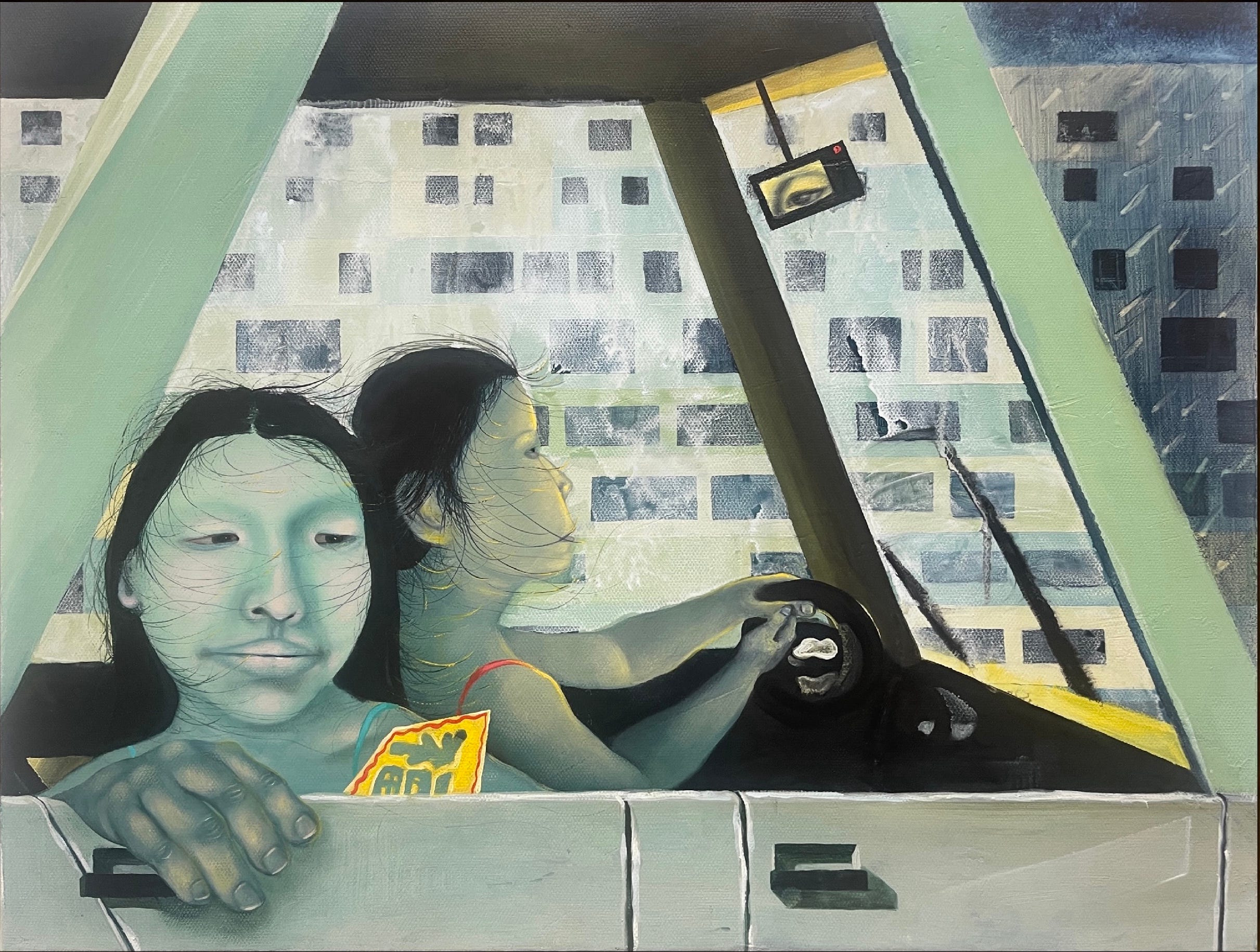
Claudia Koh. Rainfall, 2026. Oil on canvas.
Much of your practice challenges traditional boundaries within contemporary art. How do you see your current body of work responding to, or perhaps disrupting, the current cultural landscape?
I don’t think my work is trying to disrupt contemporary art as much as it is trying to offer another way of looking at the world. I’m interested in slowing things down and paying attention to the quiet relationships that often go unnoticed between people, architecture, plants, animals, and the domestic spaces we inhabit. Much of my work reflects the subtle anxieties of postmodern life, where technological advancement and increasing connectivity often coexist with loneliness, emotional distance, and a growing sense of disconnection. Rather than approaching these anxieties through dystopian narratives, I’m interested in how people quietly adapt to them. I imagine environments where different ecosystems exist independently while remaining deeply connected. Human figures, plants, animals, and domestic worlds occupy their own rhythms and identities, yet they sustain one another through companionship rather than dependence.
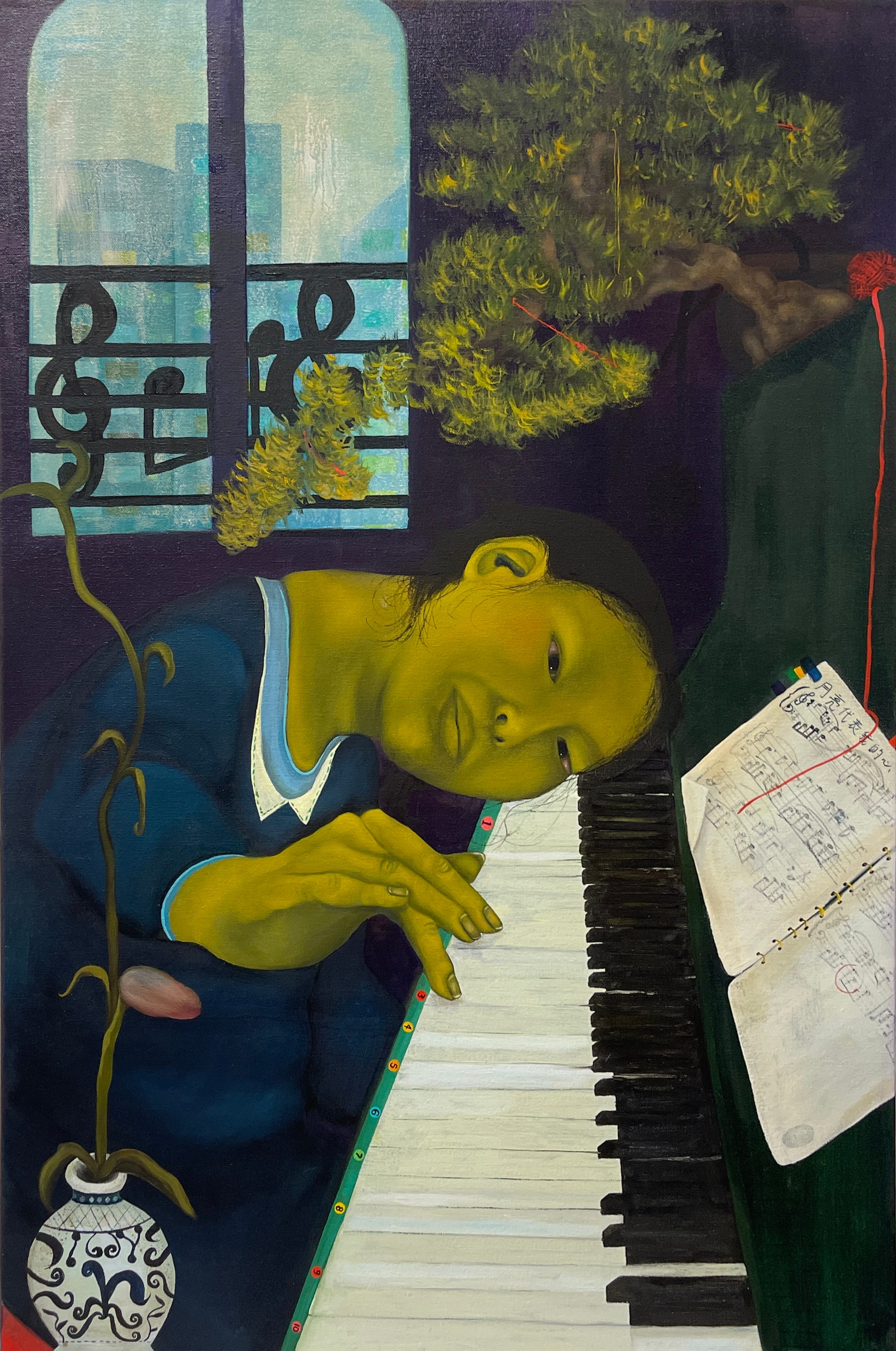
Claudia Koh. Minor Key, 2026. Oil on canvas.
I hope the work suggests that coexistence does not require uniformity. Different ecosystems can exist in isolation while still forming meaningful relationships, revealing that belonging is often found not through constant interaction, but through the quiet recognition that we are part of a larger network of life. In that sense, the paintings are less about isolation itself than about the resilience and intimacy that can emerge within it.
As an artist whose work is gaining critical international traction, how do you foresee your practice evolving next? Are there new mediums, scales, or theoretical territories you are preparing to explore?
I see my practice becoming more research driven while remaining rooted in painting. I’m interested in expanding my investigation into Singapore’s urban planning and architecture, not only as physical systems but as frameworks that shape the way people think, live, and relate to one another. Public housing policies, for example, have profoundly influenced ideas of community, family, privacy, marriage, and collective responsibility, and I want to better understand how these structures quietly shape cultural identity over time.
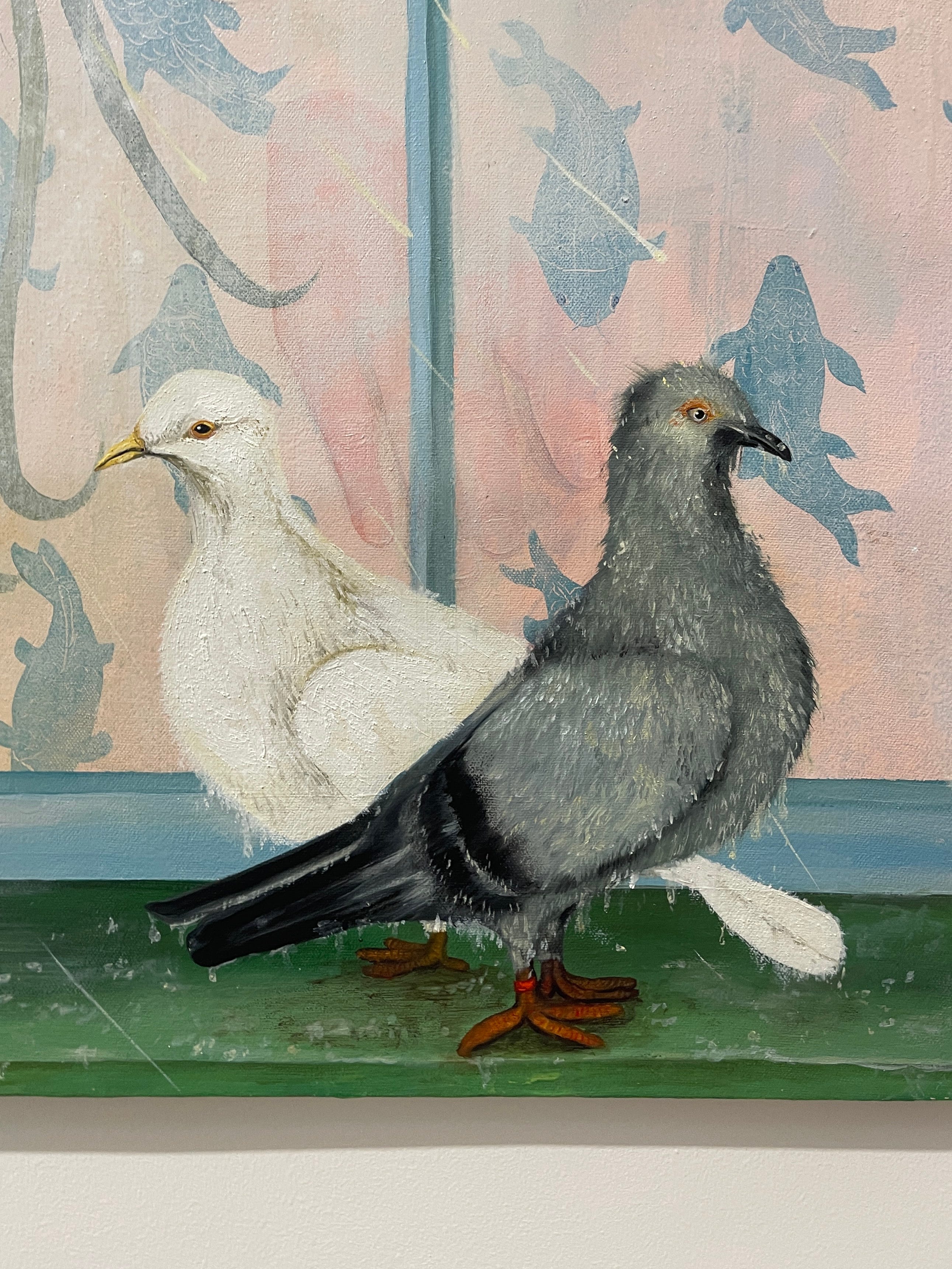
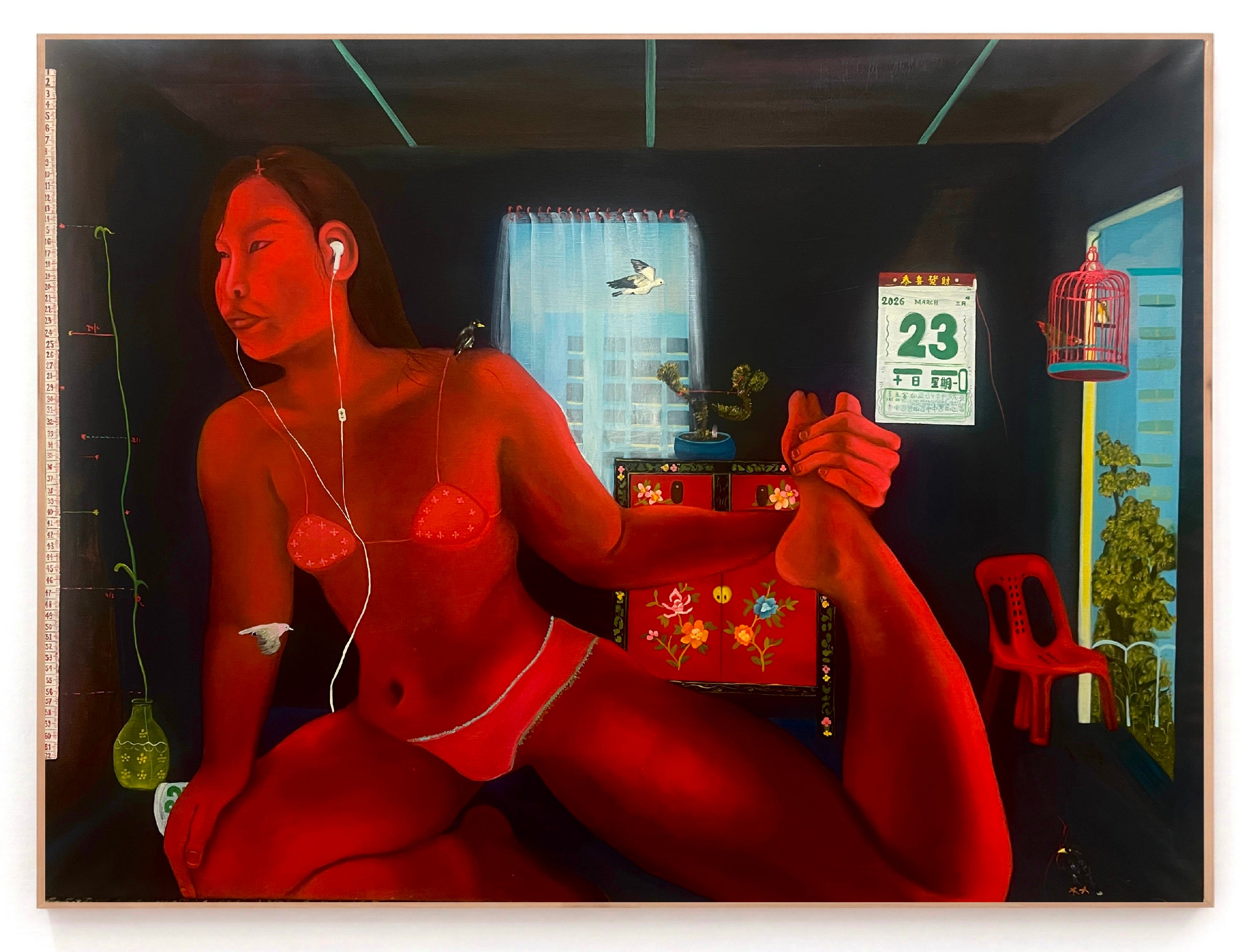
Claudia Koh. Bird, 2026. Oil on canvas. Close up.
I’m also interested in how technology increasingly mediates the preservation of life, creating new ecosystems and redefining our relationship with nature. Alongside this, I hope to deepen my research into Asian philosophies of gardening and ecology, particularly ideas of cultivation, restraint, balance, and coexistence. I imagine these ideas expanding into larger, more immersive paintings that continue to explore how the environments we design ultimately shape the ways we live, connect, and belong.
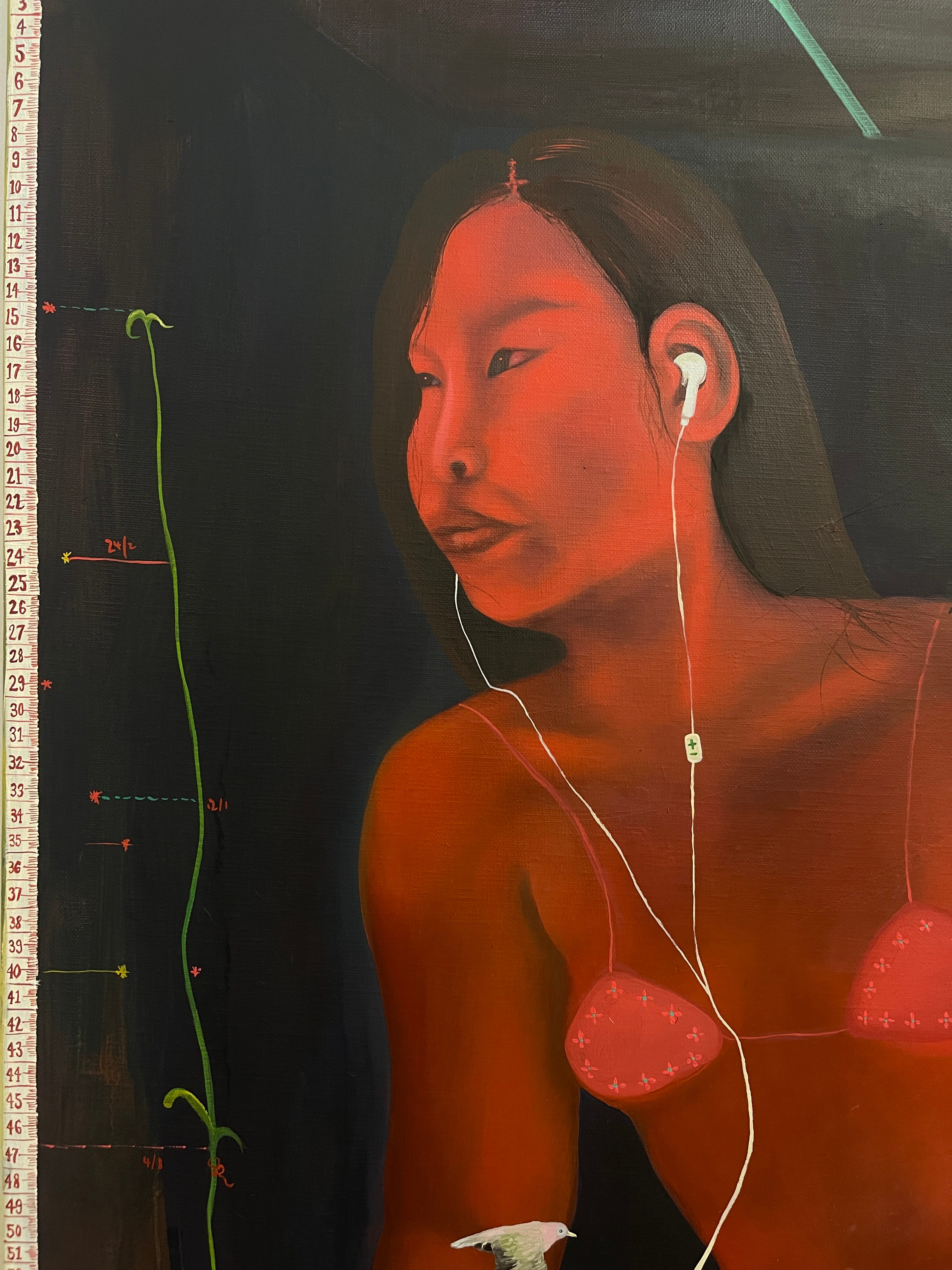
Claudia Koh. Stretch, 2026. Oil on canvas. Close up.